India’s corporate world is changing rapidly, and transportation is becoming a major part of this transformation. From employee cab services to smart fleet management, technology is improving the way companies manage daily travel for their workforce. Businesses today are focusing on employee safety, cost savings, sustainability, and operational efficiency, and modern transport technology is helping them achieve all of these goals.
Corporate transportation in India was once handled through manual systems, paper-based bookings, and unorganized vendor networks. Delays, lack of tracking, safety concerns, and poor communication were common problems. However, with the rise of digital platforms, GPS tracking, AI-powered software, electric vehicles, and mobile apps, the entire corporate commute experience is becoming smarter and more reliable.
In this blog, we will explore how technology is transforming corporate transportation in India and why businesses are investing heavily in smart mobility solutions.
Table of Contents
The Growing Need for Smart Corporate Transportation
India has seen rapid urbanization over the last decade. Cities like Bengaluru, Gurgaon, Mumbai, Hyderabad, Pune, and Chennai have become major corporate hubs. With thousands of employees commuting every day, companies are facing transportation challenges such as traffic congestion, rising fuel costs, employee safety concerns, delayed pickups & drop-offs, difficulty in managing large fleets, and high transportation expenses.
Traditional transport management methods are no longer enough. Businesses now require technology driven corporate transportation solutions that are efficient, secure, and scalable.
This demand has encouraged transport companies and tech startups to build innovative solutions for employee mobility management.
GPS Tracking is Improving Employee Safety
One of the biggest transformations in corporate transportation is the use of GPS-enabled tracking systems. Earlier, companies had limited visibility into vehicle movement. Today, real-time GPS tracking allows businesses to monitor every trip accurately.
With GPS technology, companies can track vehicle location in real time, monitor route deviations, improve employee safety, reduce unnecessary delays, and provide accurate arrival times.
Employees also feel more secure when they can track their cab location through mobile applications. For women employees working night shifts, real-time tracking has become especially important. Many organizations now consider GPS-based tracking systems a mandatory feature while selecting corporate car rental service providers in India.
Mobile Apps Have Simplified Employee Commute
Technology has made commuting much easier through mobile applications. Employees can now:
- Book rides instantly
- Receive trip notifications
- Track driver details
- Share live locations
- Get automated pickup alerts
- Rate transport services
For transport managers, mobile apps provide complete control over operations. They can manage schedules, assign vehicles, handle complaints, and analyze transport performance from a single dashboard.
This digital transformation reduces manual work and improves the overall employee experience. Companies are increasingly choosing app-based corporate transportation management systems because they help streamline communication between employees, drivers, and transport administrators.
Artificial Intelligence is Optimizing Routes
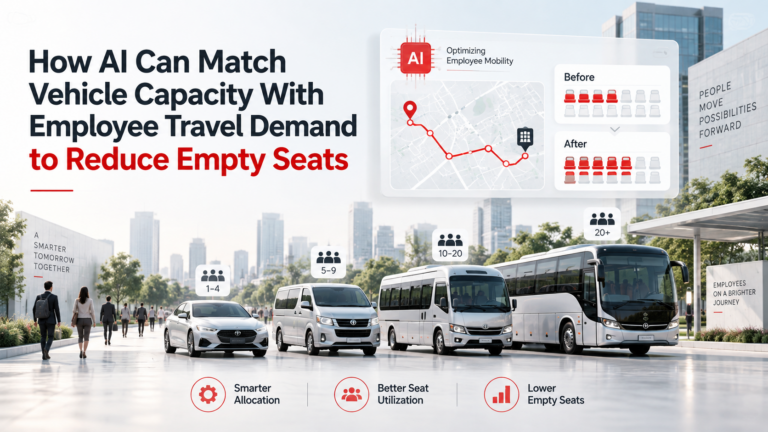
Artificial Intelligence (AI) is playing a major role in transforming fleet operations in India. AI-powered software can analyze traffic conditions, employee locations, and route patterns to create the most efficient travel plans.
Benefits of AI in corporate transportation include:
- Reduced travel time
- Lower fuel consumption
- Better route planning
- Faster pickups and drop-offs
- Reduced operational costs
For example, AI systems can automatically group employees traveling in the same direction, helping companies reduce the number of vehicles on the road. This not only cuts transportation expenses but also supports sustainable corporate travel practices.
Automation is Reducing Manual Work
Earlier, transport teams had to manage spreadsheets, driver coordination, attendance records, and trip scheduling manually. This process consumed a lot of time and often resulted in errors.
Now, automation tools are handling many transportation tasks, including auto-trip scheduling, driver allocation, attendance integration, billing and invoicing, shift-based transport planning, and emergency alerts.
Automation helps businesses save time, reduce human errors, and improve transport efficiency. Large IT companies and multinational corporations in India are already using automated employee transportation software to manage thousands of daily trips smoothly.
Electric Vehicles are Changing Corporate Mobility
The rise of electric vehicles (EVs) is another major technological shift in India’s corporate transportation sector. As companies focus more on sustainability and reducing carbon emissions, EV adoption is increasing rapidly. Many organizations are partnering with electric fleet operators to support green transportation initiatives.
Benefits of electric vehicles in corporate transportation include:
- Lower fuel costs
- Reduced carbon footprint
- Less vehicle maintenance
- Eco-friendly brand image
- Compliance with sustainability goals
Government support and EV infrastructure development are also encouraging businesses to adopt electric mobility solutions. In cities like Bengaluru, Delhi NCR, and Hyderabad, electric corporate cab services are becoming increasingly common.
Data Analytics is Improving Decision Making
Modern transportation systems generate huge amounts of data every day. Companies are now using data analytics to improve transportation planning and operational performance.
Transport analytics can provide insights into fuel consumption, driver performance, employee travel patterns, vehicle utilization, trip delays, and cost optimization.
By studying this data, businesses can identify inefficiencies and make smarter decisions. For example, if a company notices repeated delays on a specific route, they can redesign the travel schedule or select alternative pickup points. Data-driven transportation management is helping organizations reduce costs while improving employee satisfaction.
IoT Technology is Enhancing Fleet Management
The Internet of Things (IoT) is another technology revolutionizing corporate transportation in India. IoT-enabled devices installed in vehicles can monitor engine health, fuel usage, driver behavior, vehicle speed and maintenance requirements.
Fleet managers receive instant alerts if there is unusual activity or a maintenance issue. This predictive maintenance approach helps prevent vehicle breakdowns and ensures smooth transportation services. IoT technology also improves driver accountability and increases passenger safety.
Contactless and Digital Payments are Becoming Standard
Corporate transportation has also become more convenient with digital payment integration. Earlier, businesses relied heavily on cash payments, paper invoices, and manual reimbursement systems. Today, technology enables automated billing, digital invoicing, online payment processing, expense tracking, and cashless transactions, thereby creating transparency and reducing financial errors.
Digital payment systems also simplify vendor management for companies that work with multiple transport providers.
Employee Safety Technology is a Priority
Employee safety has become one of the top concerns for companies across India.
Modern transportation technology now includes advanced safety features such as SOS panic buttons, live ride monitoring, driver background verification, facial recognition systems, emergency response support and geo-fencing alerts.
These features help organizations create a safer commute environment for employees.
Many companies are now investing in secure corporate transportation systems to comply with workplace safety regulations and improve employee trust.
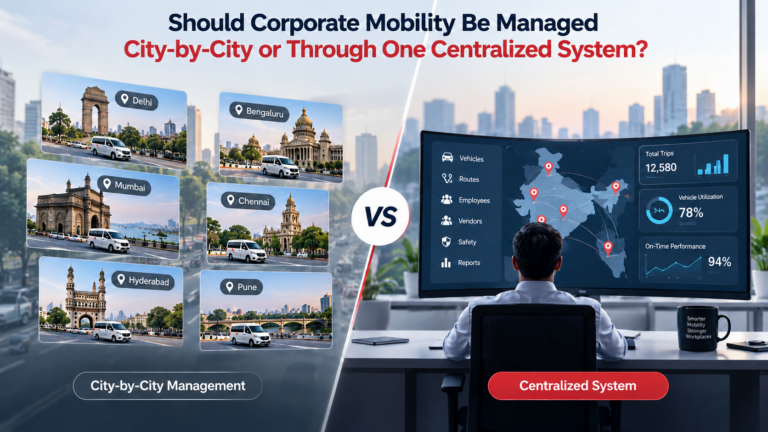
Cloud-Based Transportation Management Systems
Cloud technology is helping businesses manage transportation operations from anywhere. Cloud-based transportation management software offers:
- Centralized control
- Real-time updates
- Easy scalability
- Multi-location access
- Secure data storage
- Faster communication
For companies with offices in multiple cities, cloud platforms provide a unified transportation management solution. This flexibility is especially useful for hybrid work models and changing employee schedules.
Sustainability is Driving Innovation
Sustainability is becoming a major focus area for Indian businesses. Companies are under pressure to reduce environmental impact while maintaining operational efficiency.
Technology is supporting sustainable transportation through:
- Electric vehicles
- Shared mobility solutions
- Route optimization
- Fuel monitoring
- Carbon tracking systems
Shared employee transportation is reducing the number of individual vehicles on roads to help lower traffic congestion and pollution. Organizations are also using sustainability reports to track their green transportation efforts.
The Role of Smart Cities in Corporate Transportation
India’s smart city initiatives are also contributing to the growth of technology-driven corporate mobility. Improved digital infrastructure, intelligent traffic systems, and connected transportation networks are helping businesses improve employee travel experiences.
As smart cities continue to develop, corporate transportation systems will become even more efficient through technologies like:
- Smart traffic management
- Autonomous vehicles
- AI-based mobility platforms
- Integrated public transport systems
This will further transform how employees commute in urban India.
Challenges Still Exist
Despite major technological advancements, some challenges remain in India’s corporate transportation industry. These include high implementation costs, limited EV charging infrastructure, data security concerns, driver training requirements, and traffic congestion in metro cities.
However, as technology becomes more affordable and infrastructure improves, these challenges are expected to reduce over time. Businesses that invest early in smart transportation solutions will likely gain long-term operational advantages.
Future of Corporate Transportation in India
The future of corporate transportation in India looks highly technology-driven.
Over the next few years, we can expect:
- Increased use of AI and automation
- More electric corporate fleets
- Smart mobility integration
- Advanced employee safety systems
- Autonomous transportation technologies
- Better traffic intelligence systems
Companies will continue to focus on employee convenience, sustainability, and operational efficiency. Technology will remain at the center of this transformation.
Conclusion
Technology is completely reshaping corporate transportation in India. From GPS tracking and AI-based route optimization to electric vehicles and cloud-based fleet management systems, businesses are embracing smart mobility solutions faster than ever before.
Modern corporate transportation is no longer just about moving employees from one place to another. It is now focused on safety, efficiency, sustainability, employee satisfaction, and cost control.
As Indian businesses continue to grow and urban mobility challenges increase, technology driven transportation systems will play an even bigger role in daily operations.
Organizations that adopt advanced transportation technology today will be better prepared for the future of corporate mobility in India.