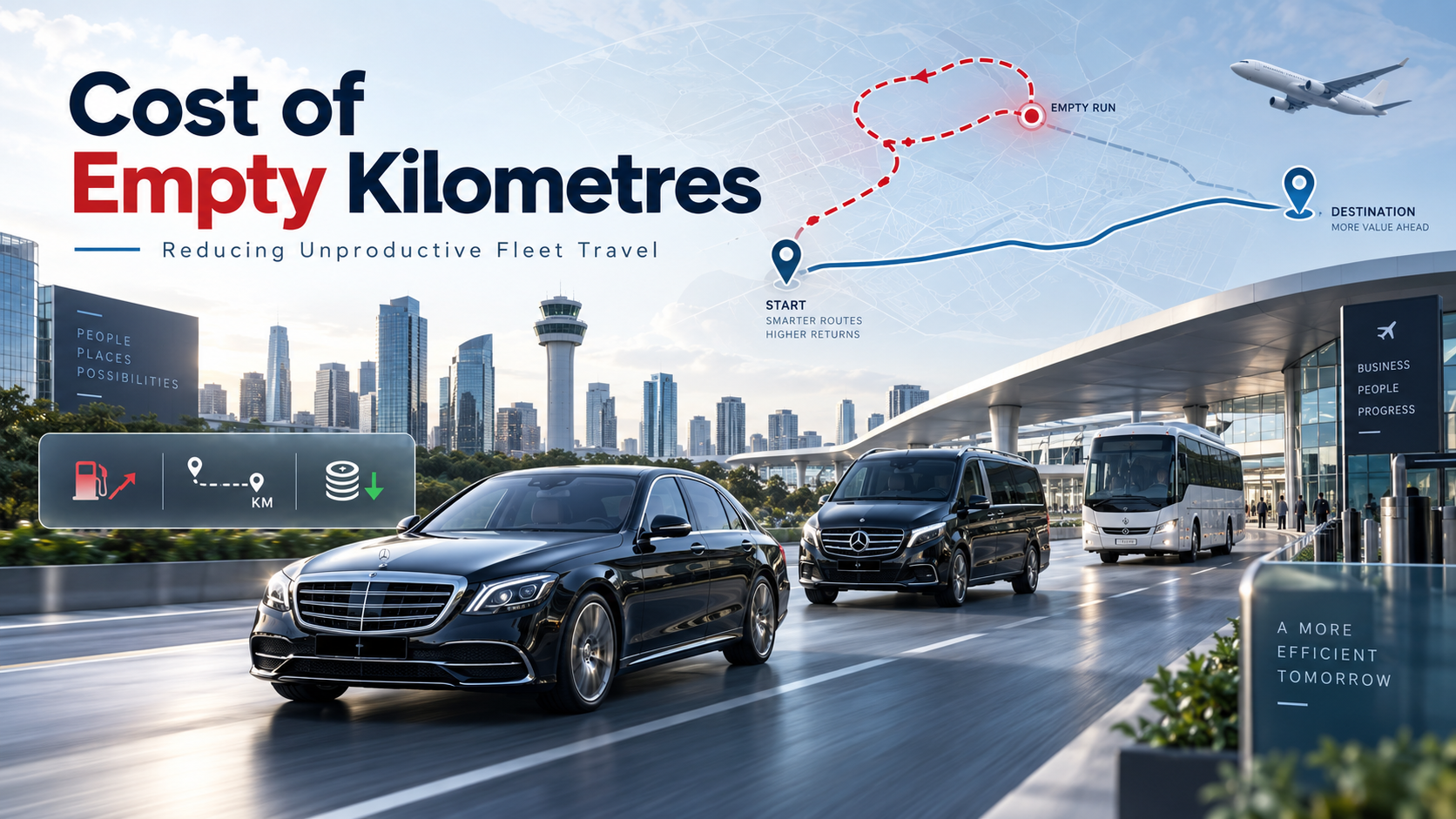
For companies that operate corporate fleets, every kilometer matters. A vehicle moving with an employee or client is serving a purpose. But what happens when that same vehicle is moving without a passenger?
This is known as an empty kilometer, and it is one of the less visible costs of corporate transportation.
An empty vehicle still consumes fuel, adds mileage, requires driver time, contributes to vehicle wear and tear, and increases operating costs. When these unnecessary kilometers happen every day across a large fleet, they can have a noticeable impact on the company’s transportation budget.
The good news is that businesses can reduce empty kilometers through better planning, technology, route optimization, and professional corporate transportation management.
Table of Contents
What are Empty Kilometers?
Empty kilometers are the distance travelled by a vehicle when it is not carrying a passenger or delivering a service.
For example, imagine a corporate car drops an employee at an office and then drives 15 kilometers back to its base without another passenger. Those 15 kilometers are unproductive travel.
The same problem can occur when a vehicle:
- Travels to pick up a passenger from a distant location
- Returns to the depot after completing a trip
- Moves between assignments without a passenger
- Waits in one area and then travels empty to another location
- Returns empty after an airport transfer
A few empty kilometers may not seem important. But thousands of such trips across a corporate fleet can create a significant expense.
Empty Kilometers Calculator
See the real financial impact of empty fleet travel beyond fuel alone.
Calculating…
Illustrative estimates only. Actual fleet costs vary by vehicle, location, utilisation, labour rates and operating model.
Why Empty Kilometers Cost More Than Fuel?
Fuel is only one part of the problem.
Every unnecessary kilometer can contribute to:
- Fuel consumption: More distance means more fuel usage.
- Vehicle maintenance: Tires, brakes, engine components, and other parts experience additional wear.
- Driver costs: Chauffeurs spend working hours travelling without transporting anyone.
- Vehicle depreciation: Higher mileage can reduce the long-term value of fleet vehicles.
- Lost capacity: A vehicle travelling empty cannot be used for another passenger or assignment.
This means companies should look at total fleet operating costs, rather than calculating empty travel only through fuel expenses.
How Empty Travel Affects Corporate Transportation?
Empty kilometres can become particularly expensive when a company manages airport transfers, executive transportation, employee shuttles, and corporate events.
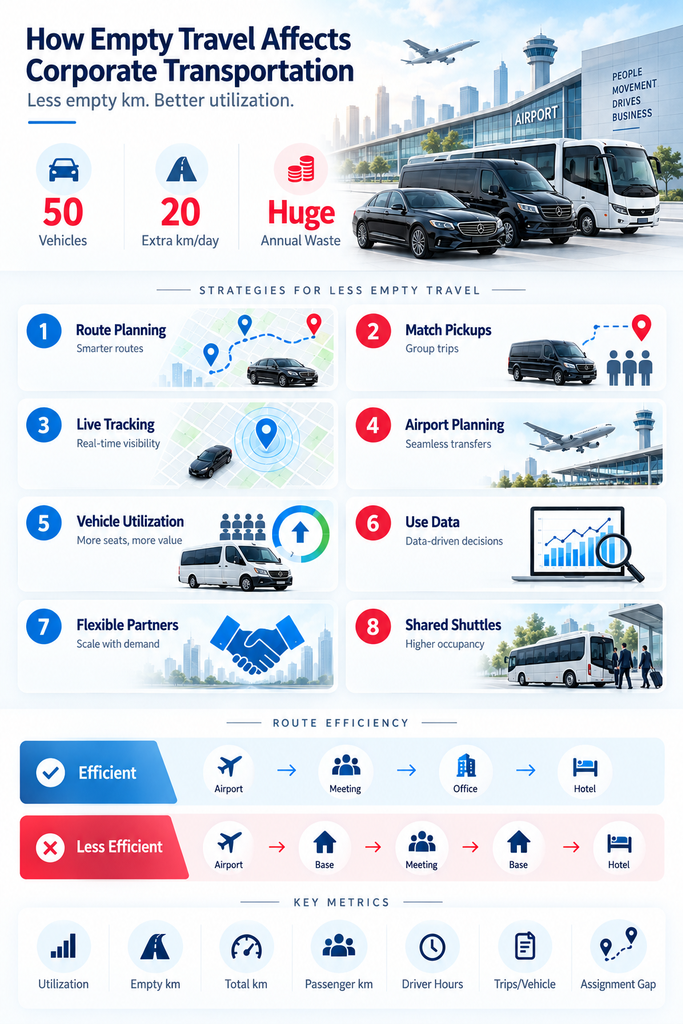
Consider a company with 50 vehicles. If each vehicle travels just 20 unnecessary kilometers every working day, the fleet could accumulate hundreds of thousands of unproductive kilometers over a year.
This is why fleet utilization is an important metric for corporate transportation managers.
The goal is not simply to reduce the number of vehicles. It is to make better use of the vehicles already available.
1. Improve Route Planning
One of the simplest ways to reduce empty kilometers is better route planning. Instead of sending a vehicle back to its base after every trip, fleet managers can look for another nearby assignment.
For example:
Airport – Client Meeting – Office – Hotel
can be more efficient than:
Airport – Base – Client Meeting – Base – Hotel
Using efficient routes can reduce unnecessary driving while also improving vehicle availability. Modern fleet management software can help transportation teams identify efficient routes and reduce unnecessary vehicle movement.
2. Match Pickups With Drop-Offs
Another effective strategy is to match a vehicle’s next pickup with its current location. Suppose a driver drops an employee at a business park. If another employee needs transportation from a nearby location, assigning the same vehicle can prevent an empty return journey.
This type of trip optimization can increase vehicle utilization and reduce deadhead miles. It requires good visibility of upcoming bookings, which is why centralized transportation scheduling is important.
3. Use Real-Time Fleet Tracking
Knowing where every vehicle is can make a major difference. GPS fleet tracking allows transportation managers to see vehicle locations, current trips, and available vehicles in real time.
Instead of assigning the closest-looking vehicle based on guesswork, managers can identify which vehicle is actually closest to the next passenger. This can reduce unnecessary travel and improve response times.
4. Plan Airport Transfers Carefully
Airport transportation can generate significant empty kilometers.
A vehicle may travel a long distance to pick up a passenger and then return empty after dropping them at their hotel.
Companies can reduce this by scheduling another passenger or assignment near the drop-off location whenever possible.
For businesses handling frequent corporate airport transportation, analyzing airport pickup and drop-off patterns can reveal opportunities to reduce deadhead travel.
5. Increase Vehicle Utilization
A vehicle sitting unused for most of the day can be just as inefficient as one travelling empty.
Fleet managers should monitor:
- Vehicle utilization
- Empty kilometers
- Total kilometers
- Passenger kilometers
- Driver hours
- Trips per vehicle
- Average distance between assignments
These metrics help identify vehicles that are being underused and routes that create unnecessary travel.
6. Use Data to Identify Patterns
Reducing empty kilometers is easier when companies understand when and where they occur. For example, data might show that several vehicles return empty from a particular business district every evening.
Instead of treating each trip separately, the company can redesign its transportation schedule around this pattern.
Corporate fleet analytics can help transportation managers identify recurring inefficiencies and make better decisions based on actual travel data.
7. Consider On-Demand Transportation Partners
Not every company needs to own and operate a large fleet. During busy periods, companies may use professional corporate ground transportation providers to handle additional demand.
This can reduce the need to keep excess vehicles available throughout the year.
A flexible transportation model can help businesses match vehicle supply with actual demand and avoid unnecessary fleet costs.
8. Use Shared Corporate Shuttles
Employee transportation can also create empty kilometers when individual vehicles are used for separate trips. Where schedules and locations allow, companies can introduce employee shuttle services.
A single shuttle carrying multiple employees can reduce individual vehicle movements while improving transportation efficiency.
This works particularly well for business parks, offices, campuses, and shift-based operations.
How to Measure Empty Kilometers?
Companies cannot improve what they do not measure.
A useful starting point is:
Empty Kilometers / Total Vehicle Kilometers × 100 = Empty Kilometer Percentage
Tracking this number regularly can show whether fleet efficiency is improving.
Companies can also compare empty kilometers by vehicle, driver, route, location, time of day, and type of transportation service. This creates a clearer picture of where money is being lost.
The Business Case for Reducing Empty Kilometers
Reducing unproductive travel can deliver several benefits at the same time.
It can help companies:
- Lower fuel costs
- Reduce vehicle maintenance expenses
- Improve fleet utilization
- Reduce driver downtime
- Increase vehicle availability
- Lower emissions
- Improve transportation efficiency
- Reduce overall corporate travel costs
Even a small improvement in fleet utilization can make a noticeable difference when applied across a large corporate fleet.
Conclusion
Empty kilometers may not appear as a separate line on a transportation invoice, but they are a real operating cost. Every unnecessary kilometer consumes fuel, adds vehicle wear, uses driver time, and reduces the productive capacity of a corporate fleet.
The solution is not simply to tell drivers to travel less. Companies need better fleet management, route optimization, real-time tracking, transportation scheduling, and data analysis. By understanding where empty kilometers occur and changing the way vehicles are assigned, businesses can turn unproductive travel into more efficient fleet operations.
For companies looking to control corporate transportation costs, reducing empty kilometers is one of the simplest places to start.