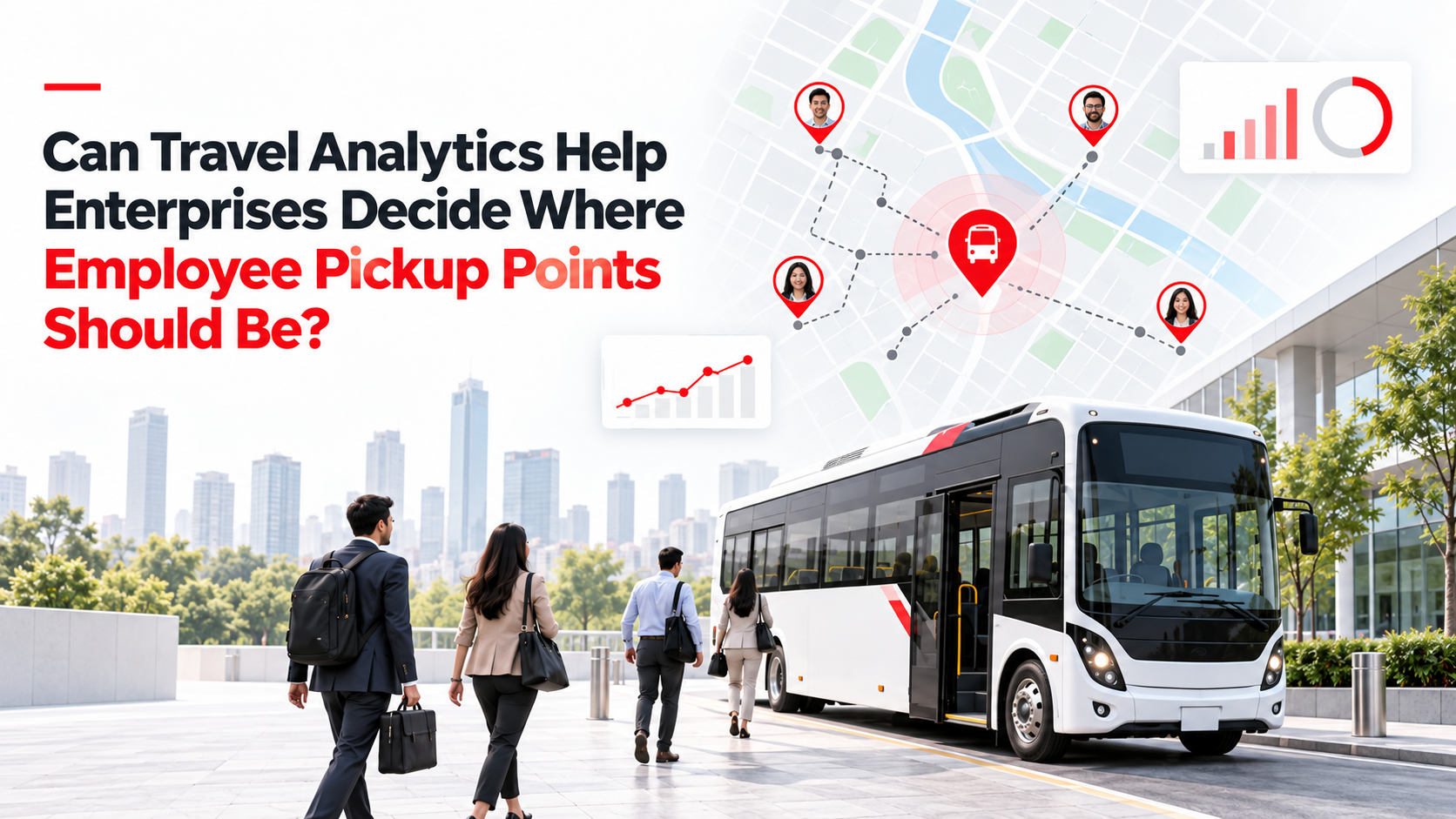
Choosing the right employee pickup points is an important part of managing corporate transportation. A pickup point that works well for one group of employees may not be convenient for another. Some employees may have to walk too far, while others may face long waiting times or unnecessary detours before reaching the office.
For enterprises with hundreds or thousands of employees, deciding pickup locations based only on assumptions can make transportation more complicated. This is where travel analytics can help.
Travel analytics uses data from employee travel patterns, routes, vehicle movement, travel times, and other transportation information to help companies make better decisions. Instead of simply asking where employees live, organizations can study how employees actually travel and where pickup points could work more efficiently.
When used properly, travel analytics can help enterprises plan safer, more convenient, and more efficient employee transportation routes.
Table of Contents
What is Travel Analytics in Employee Transportation?
Travel analytics means collecting and studying transportation-related data to understand how people and vehicles move.
In an employee transportation management system, this data may include employee locations, pickup and drop-off points, route distances, travel times, vehicle utilization, traffic patterns, and trip frequency.
For example, if employees from a particular area regularly travel to the same office but are currently using several different pickup points, travel data may show that some locations could be consolidated into a more practical pickup point.
Similarly, if employees are spending a long time reaching a particular pickup location, the company can review whether another nearby location would be more convenient.
The aim is not simply to reduce the number of pickup points. The goal is to find locations that better balance employee convenience, travel time, safety, and operational efficiency.
Why Are Employee Pickup Points Important?
Pickup points are one of the first parts of an employee’s daily commute. If the location is inconvenient, the entire transportation experience can become difficult. An employee may have to walk a long distance, cross a busy road, wait in an uncomfortable location, or leave home much earlier than necessary to reach the vehicle.
For companies, poorly planned pickup points can also increase route distance, travel time, fuel consumption, and vehicle usage. This makes pickup point optimization an important part of corporate transportation planning.
A well-planned pickup point can help employees reach their vehicle more easily while allowing the transport team to create practical routes.
How Can Travel Analytics Help Choose Pickup Points?
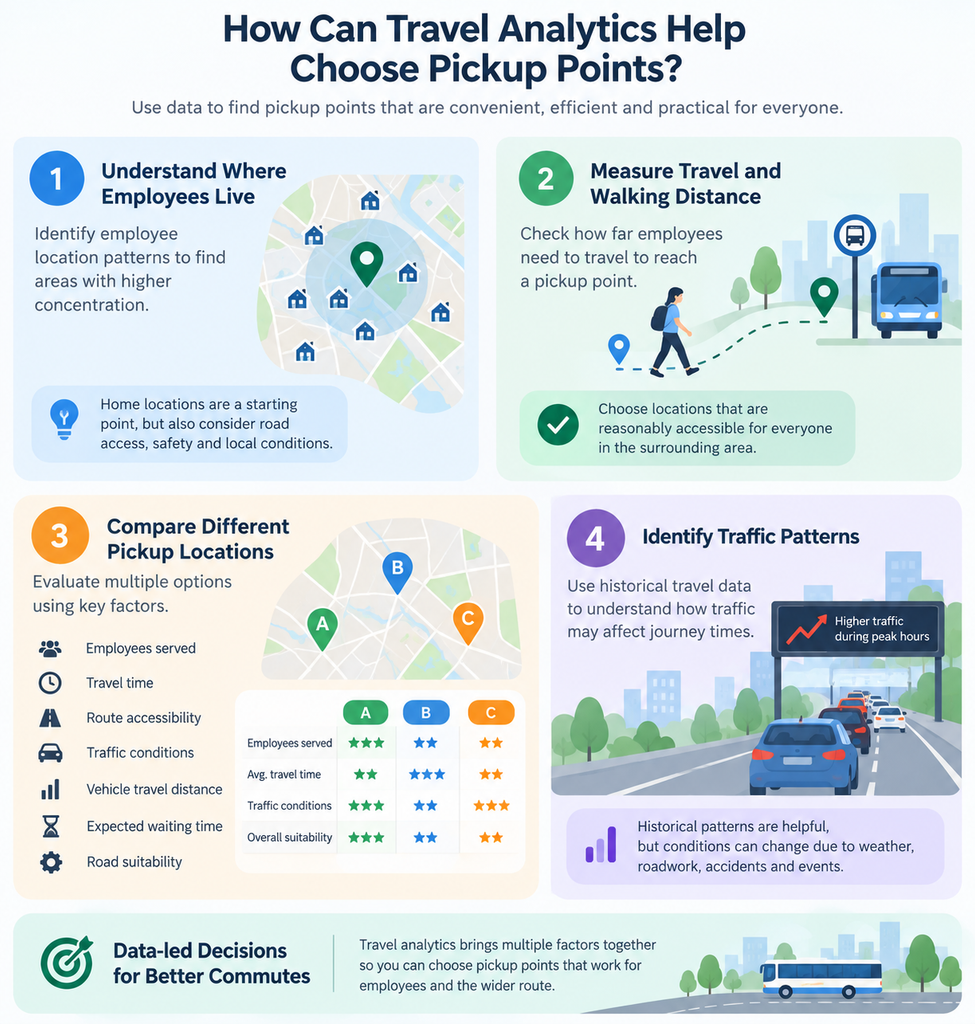
Travel analytics can support pickup point decisions in several ways. Instead of relying on a single data point, companies can look at multiple factors before finalizing a location.
Understanding Where Employees Live
The first step is understanding employee location patterns. Travel analytics can help transport teams identify areas where employees are concentrated. If a large number of employees live within a particular neighborhood or nearby areas, the company can study whether one strategically located pickup point could serve them.
This can make route planning more organized and reduce unnecessary vehicle movement. However, employee home locations alone should not determine the final pickup point. Road access, safety, traffic, walking distance, and local conditions also need to be considered.
Measuring Travel and Walking Distance
A pickup point may look convenient on a map but may not be practical for employees. Travel analytics can help estimate the distance employees need to travel to reach a pickup location. If employees regularly have to travel too far to reach a stop, the company can review nearby alternatives.
This can improve the overall employee commute experience.
For example, instead of selecting a pickup point simply because it is close to the largest group of employees, transport teams can look for a location that is reasonably accessible to employees across the surrounding area.
Comparing Different Pickup Locations
Sometimes there may be several possible pickup points in the same area. Travel analytics can help compare them based on factors such as:
- Average employee travel distance
- Expected travel time
- Route accessibility
- Traffic conditions
- Number of employees served
- Vehicle travel distance
- Expected waiting time
- Road suitability
This creates a more structured approach to employee transportation planning.
Rather than choosing a location based only on convenience for one group, companies can consider the impact on the wider route.
Identifying Traffic Patterns
Traffic can significantly affect employee transportation. A pickup point located near a busy junction may create delays during peak office hours. Another location only a short distance away may provide easier vehicle access.
By studying historical travel data and traffic patterns, companies can understand how different pickup locations may affect journey times.
This does not mean analytics can predict every traffic situation. Road conditions can change because of construction, accidents, weather, events, or other factors. However, historical patterns can provide useful information for route planning.
Using Travel Analytics to Improve Employee Safety
Convenience is important, but employee safety should also be considered when selecting pickup points.
A pickup point may be geographically close to an employee but still not be a suitable location if it has poor road access, limited visibility, heavy traffic, or unsafe pedestrian movement.
Travel analytics can help identify locations that require closer review. However, data should be combined with on-ground assessment and company safety policies. Transport teams can consider factors such as lighting, road conditions, traffic movement, accessibility, and the ability of the vehicle to stop safely.
For late-night employee transportation, these considerations become particularly important.
The final decision should therefore combine data-driven route planning with practical safety checks.
Can Analytics Reduce Unnecessary Vehicle Travel?
Yes, better pickup point planning can potentially reduce unnecessary vehicle movement. Imagine a route where a vehicle has to make several small detours to collect employees from closely located streets. If travel data shows that employees can reasonably access a central pickup point, the company may be able to redesign the route.
This can reduce unnecessary route kilometres and make trips more organised. However, reducing vehicle distance should not come at the cost of employee convenience or safety. A shorter route is not automatically a better route if employees have to walk much farther or use an unsuitable pickup location. The objective should be to find a practical balance.
Travel Analytics Can Support Better Vehicle Utilisation
Pickup point planning is also connected to vehicle utilisation.
If several pickup points serve only a small number of employees, companies may have an opportunity to review how vehicles are allocated. Data can show how many employees are using each route and how much capacity is being used.
This information can help transport teams understand whether routes are appropriately planned or whether certain routes need adjustment.
Better utilisation can support more efficient employee transportation operations while maintaining service requirements.
Combining Analytics With Employee Feedback
Data can show what is happening, but employees can explain why it is happening. This is why employee feedback should be considered alongside travel analytics.
For example, analytics may show that employees are consistently reaching a pickup point late. The reason could be an inconvenient walking path, a difficult crossing, poor accessibility, or a change in local traffic conditions.
Employee feedback can help transport teams understand these issues and make better decisions.
A combination of commute data and employee feedback can therefore provide a more complete picture.
What Data Should Enterprises Track?
To make travel analytics useful, companies need access to relevant and reliable data. Some useful data points include:
- Employee location clusters
- Pickup and drop-off locations
- Average travel time
- Route distance
- Vehicle movement
- Pickup punctuality
- Waiting time
- Vehicle occupancy
- Traffic patterns
- Route deviations
- Employee feedback
- Safety-related observations
The exact data required will depend on the company’s transportation model, employee distribution, operating locations, and policies.
A Data-Driven Approach to Pickup Point Planning
A practical approach to employee pickup point optimization can follow a simple process.
First, the company can map employee locations and existing pickup points. Next, it can study travel patterns, route distances, traffic conditions, and vehicle utilisation.
The transport team can then identify possible alternative pickup locations and compare their impact on employee travel and vehicle routes.
Before implementation, shortlisted locations should be checked for road access, safety, visibility, and practical vehicle stopping conditions.
Once a new pickup point is introduced, the company can continue monitoring its performance. If travel time, waiting time, or employee feedback shows that changes are needed, the route can be reviewed again. This makes pickup point planning an ongoing process rather than a one-time decision.
Conclusion
Travel analytics can help enterprises make more informed decisions about employee pickup points. By studying employee travel patterns, commute distances, route performance, traffic conditions, vehicle utilisation, and feedback, companies can identify locations that may work better for their transportation network.
However, analytics should support decision-making rather than replace practical judgement. A pickup point should not be selected only because it looks efficient on a map. Employee convenience, accessibility, road conditions, and safety also need to be considered.
For organisations managing large-scale corporate employee transportation, combining travel analytics with route planning, employee feedback, and on-ground checks can create a more structured approach to transportation management.
The result can be a transportation system where pickup points are planned around real travel patterns instead of assumptions, helping employees experience a smoother daily commute while giving transport teams better visibility and control over their operations.