
Employee transportation services in India have experienced a major shift in recent years. What was once a simple service has evolved into a very important component of the current business strategy. In 2026, companies are now aiming not just to provide transportation but also to offer safe, efficient, and tech-enabled commuting options that enhance employee satisfaction and boost productivity.
With the increase of IT parks, hybrid work arrangements, and urban congestion, organizations across India are re-evaluating how their employees commute. This guide explores everything you need to understand about employee transport services, including their importance and current industry trends.
What are Employee Transportation Services?
Employee transport services are organised travel arrangements provided by companies to help employees commute between their homes and workplaces. These services are common in sectors such as IT, BPO, manufacturing, healthcare, and logistics, where employees often work in shifts or long hours.
In today’s landscape, these services are no longer limited to buses or vans, because companies now rely on advanced, tech-enabled platforms that manage everything from route planning to real-time vehicle tracking. Employees can book rides via mobile apps, receive notifications, and even track their vehicles in real time to make the entire process more seamless and reliable.
Get round-the-clock support with our rides and services.
Why Employee Transportation Services are Important in India
The urban infrastructure of India is often congested, which can make daily commuting stressful, time-consuming, and unpredictable. This is where employee transport becomes even more important.
- Improved Employee Productivity: Long, stressful commutes can reduce productivity. However, when companies provide reliable transport, employees arrive on time and with less fatigue, improving overall work performance.
- Enhanced Safety and Security: Employee safety, especially for women employees who are working night shifts, is a top priority. Therefore, services such as GPS tracking, driver verification, panic buttons, and live ride monitoring are very helpful.
- Cost Efficiency for Employees: The cost of travelling on a daily basis in cities can be high. So, company-provided transport reduces this burden and is a valuable employee benefit.
- Better Employee Retention: Convenient options for daily commute increase job satisfaction. Therefore, employees are more likely to stay with companies that prioritise their daily comfort.
Key Features of Modern Employee Transport Solutions
Employee transportation services in 2026 will be run by technology. Here are some key features companies look for:
- Real-Time Tracking: Employees and admins can now have access to the real-time tracking of vehicles, which ensures transparency and reduces uncertainty about arrival times.
- Route Optimization: Advanced algorithms help optimize routes based on traffic, employee locations, and demand patterns, thereby reducing travel time and fuel costs.
- Automated Scheduling: Transport systems can automatically assign routes, shifts, and vehicles based on the schedules of employees.
- Mobile App Integration: Employees can book rides, check schedules, and receive notifications via mobile apps.
- Safety Compliance: Modern systems include features such as:
-
-
- SOS alerts
- Driver background checks
- Trip monitoring
- Emergency response systems
-
Latest Trends in Employee Transportation 2026
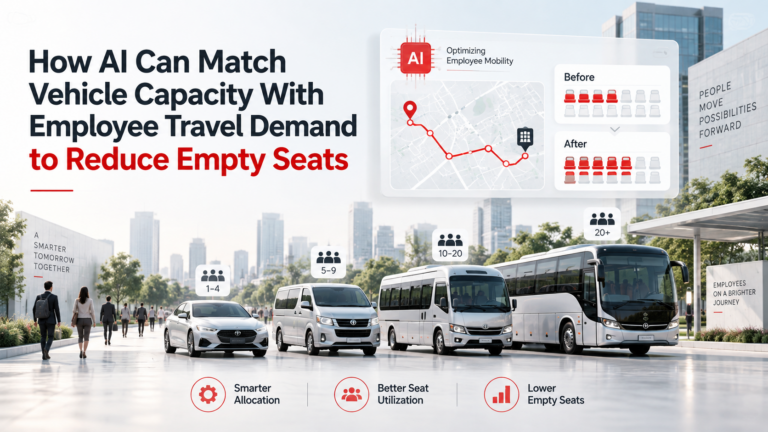
Employee transportation services in India are rapidly evolving, due to the technological advances and changing workplace patterns. A key development is the increased use of artificial intelligence in fleet management, which helps to forecast demand, optimize routes, and boost efficiency.
The shift toward electric vehicles is also increasing, as many companies move to EV fleets to meet sustainability targets and cut long-term fuel expenses. Hybrid work arrangements present new challenges and opportunities, prompting transportation systems to adapt flexibly to employee attendance and ensure resource efficiency.
Companies are now majorly relying on data analytics, utilizing dashboards and reports to monitor usage, control costs, and pinpoint areas where improvement is needed. This data-centric strategy facilitates smarter decision-making and ongoing optimisation.
Challenges in Employee Transportation in India
Although technological progress has improved various sectors over the year, but, employee transportation in India still encounters various issues.
- Traffic congestion is one of the major problems, especially in large cities, which causes delays that can disrupt schedules and decrease efficiency.
- Cost control is another main concern with the rise in fuel prices, vehicle maintenance costs, and wages for drivers can heavily affect budgets. Companies must find a balance between keeping costs down and maintaining service quality.
- Making sure the safety across all routes and shifts adds another layer of complexity that requires rigorous monitoring, regular audits, and strict compliance.
- Furthermore, managing transportation for a fluctuating workforce with diverse schedules presents additional challenges.
How to Choose the Right Employee Transport Service
Choosing the right transportation solution requires thorough evaluation. Companies should start by assessing their workforce size, locations, and commuting patterns. A scalable solution is important, as transportation needs may grow over time.
Technology needs to be the main consideration with the growing decades. Platforms that offer real-time tracking, mobile access, and analytics provide an even better control and visibility. Safety features must also be a top priority, including driver verification, GPS tracking, and emergency support systems.
Another facter is cost, but it should not be the only one. Organizations should consider the overall value, including reliability, service quality, and long-term benefits. Choosing a reliable vendor with a proven track record can make a big difference.
Benefits for Employers and Employees
Employee transportation services benefit both companies and their employees. For companies, they can boost productivity of their employees, cut down on absenteeism, and strengthen the reputation as a good place to work. Offering transport also shows that a company genuinely cares about employee safety and well-being.
For employees, the impact is just as meaningful. A dependable commute takes away a lot of daily stress and saves time to make it easier to maintain a healthy work-life balance. It can also reduce travel costs and offer a greater sense of security, especially for those working late hours.
Get round-the-clock support with our rides and services.
Future of Employee Transportation in India
Looking ahead, employee transportation in India is only going to get smarter and more sustainable. We will likely see mobility solutions becoming more connected with city infrastructure to make the daily commute smoother and less stressful.
While technologies like autonomous vehicles are still evolving, they could eventually find a place in corporate transport. At the same time, AI will help companies to tailor commute options to individual needs, giving employees more flexibility and comfort.
Sustainability will also stay front and center, with more organizations shifting toward electric vehicles and shared rides. With the growing cities and expansion of businesses, having efficient and reliable transportation in place will not only be helpful, but also important for long-term success.
In 2026, employee transportation services in India are no longer just about convenience. It has become a key part of how businesses function. A well-managed commute can have a real impact on productivity, safety, and even how employees feel throughout their workday.
With the correct mix of technology, careful planning, and reliable service partners, companies can create transportation systems that really support their people. In a fast-growing and dynamic country like India, companies that focus on how employees travel to and from work are more likely to stay ahead.