
Businesses that rely on vehicles have an important decision to make: should they continue with a traditional fleet powered mainly by petrol or diesel, or move toward a green fleet that uses electric, hybrid, or other cleaner vehicles?
The answer is not the same for every business. A green fleet can reduce fuel costs, emissions, and long-term operating expenses, while a traditional fleet may offer lower upfront costs and easier refueling. The right choice depends on your budget, daily vehicle usage, routes, charging options, and long-term business goals.
In this guide, we compare green fleet vs traditional fleet to help businesses understand the costs, benefits, challenges, and practical considerations before making a decision.
Table of Contents
What is a Green Fleet?
A green fleet is a group of vehicles designed to reduce fuel use, emissions, and environmental impact. It can include:
- Electric vehicles (EVs)
- Hybrid vehicles
- Plug-in hybrid vehicles
- CNG or alternative-fuel vehicles
- Fuel-efficient vehicles
- Vehicles supported by smart fleet management systems
The main goal of green fleet management is to lower operating costs while reducing carbon emissions.
What is a Traditional Fleet?
A traditional fleet mainly uses petrol or diesel-powered vehicles. These fleets are still common because they offer established infrastructure, familiar technology, and a wide choice of vehicles. For businesses that need long-distance travel, heavy-duty transport, or quick refueling, traditional vehicles can still be practical.
However, rising fuel prices, maintenance costs, environmental regulations, and sustainability targets are encouraging businesses to consider cleaner alternatives.
Green Fleet vs Traditional Fleet: Key Differences
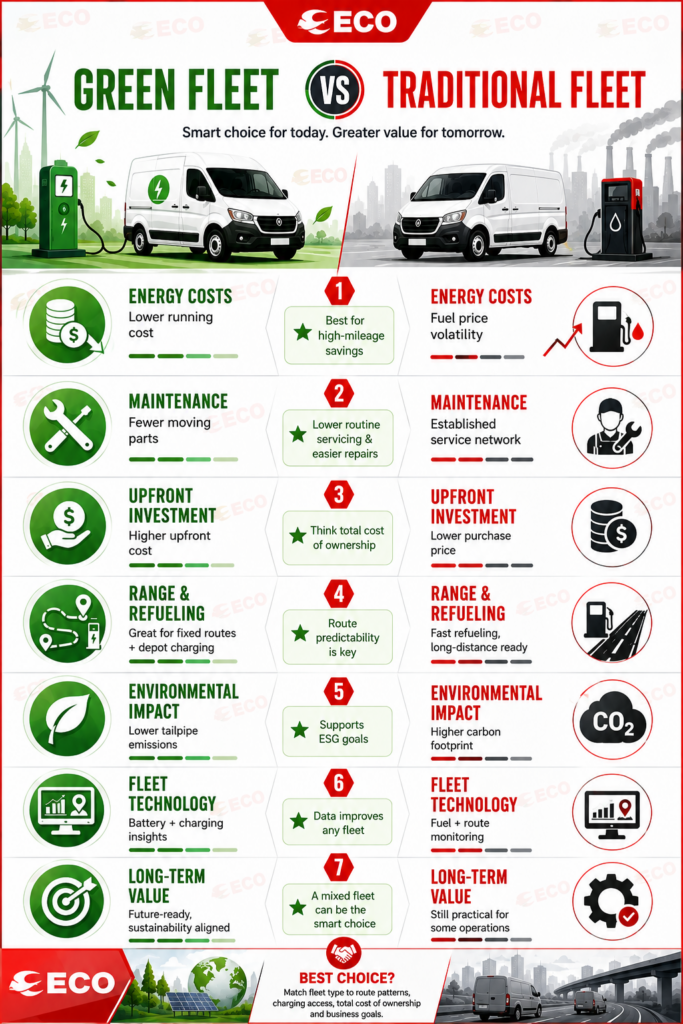
Choosing between a green fleet and a traditional fleet requires businesses to consider more than just the vehicle purchase price. Factors such as operating costs, maintenance, fuel efficiency, vehicle performance, environmental impact, and total cost of ownership (TCO) can significantly influence the overall value of a fleet.
While a green fleet can help businesses reduce fuel consumption, maintenance expenses, and carbon emissions, a traditional fleet continues to offer advantages such as wider vehicle availability, established refueling infrastructure, and convenience for long-distance operations.
Here are the key differences businesses should consider:
1. Fuel and Energy Costs
Fuel is one of the largest ongoing expenses for many commercial fleets. Traditional vehicles depend on petrol or diesel, making operating costs sensitive to changes in fuel prices.
Electric vehicles (EVs), on the other hand, use electricity and can offer lower energy costs per kilometre, depending on local electricity rates and charging arrangements. For high-mileage fleets, these savings can have a significant impact on overall fleet operating costs.
Key takeaway: Green fleets can provide greater potential for long-term energy savings, particularly for vehicles with high and predictable daily mileage.
2. Maintenance and Servicing
Maintenance requirements can vary considerably between green and traditional fleet vehicles.
Electric vehicles have fewer moving components than vehicles powered by internal combustion engines. They do not require engine oil changes and generally have fewer engine-related maintenance requirements.
Traditional petrol and diesel vehicles require regular servicing of engines, oil, filters, exhaust systems, and other mechanical components. However, businesses already have access to established servicing networks for conventional vehicles.
Key takeaway: Green fleet vehicles can reduce routine maintenance requirements, while traditional fleets benefit from well-established repair and service infrastructure.
3. Initial Investment
The upfront cost of a vehicle is an important consideration when planning a fleet electrification strategy. Some electric and hybrid vehicles may have a higher purchase price than comparable petrol or diesel models.
However, focusing only on the initial investment can provide an incomplete picture. Businesses should evaluate the total cost of ownership, including energy, maintenance, insurance, depreciation, financing, and infrastructure costs.
Key takeaway: A higher upfront cost does not necessarily mean higher overall fleet costs. Long-term operating expenses should be considered before making a decision.
4. Range and Refueling
Traditional vehicles currently have an advantage when it comes to refueling convenience. Petrol and diesel stations are widely available, and vehicles can generally be refueled within minutes.
EV charging infrastructure is expanding, but charging times and availability can vary. Businesses operating vehicles on fixed routes or returning them to a central depot can overcome many of these challenges by installing fleet charging infrastructure.
Key takeaway: Traditional fleets may be better suited to operations requiring frequent long-distance travel, while EVs can work particularly well for predictable routes and depot-based operations.
5. Environmental Impact
Environmental performance is another major difference between the two fleet types.
Traditional petrol and diesel vehicles produce tailpipe emissions and contribute to a business’s transportation-related carbon footprint. A green fleet, particularly one that includes electric vehicles, can help reduce direct vehicle emissions.
Adopting cleaner vehicles can also support corporate sustainability goals, ESG initiatives, and carbon reduction targets.
Key takeaway: Green fleets offer a clear advantage for businesses looking to reduce fleet emissions and improve their environmental performance.
6. Fleet Management and Technology
Modern fleet management software can help businesses improve the performance of both green and traditional fleets. GPS tracking, route optimisation, driver behaviour monitoring, fuel or energy monitoring, and vehicle maintenance tracking can help reduce unnecessary costs.
For green fleets, fleet technology can also provide information about battery usage, charging patterns, vehicle range, and energy consumption. This data allows fleet managers to identify inefficiencies and make better vehicle replacement decisions.
Key takeaway: Technology can help businesses maximise the efficiency and return on investment of any fleet, regardless of the vehicle type.
7. Long-Term Business Value
A fleet decision should support both current operations and future business requirements. Traditional vehicles may remain practical for certain applications, but increasing fuel costs, sustainability expectations, and changing regulations are encouraging many businesses to explore cleaner transportation options.
A green fleet strategy can help organisations reduce operating costs while supporting long-term sustainability objectives. However, full fleet electrification may not be suitable for every business or every vehicle.
Key takeaway: The most practical solution may be a gradual transition or a mixed fleet, combining electric, hybrid, and traditional vehicles according to specific operational needs.
Ultimately, the choice between a green fleet and a traditional fleet should be based on fleet utilisation, operating routes, vehicle requirements, charging availability, total cost of ownership, and long-term business goals rather than a one-size-fits-all approach.
Does a Green Fleet Save Money?
A common question is whether green fleet vehicles actually reduce business costs.
They can, particularly when vehicles have high daily mileage and predictable routes. Lower energy and maintenance costs can offset a higher purchase price over time. However, businesses should conduct a fleet cost analysis before making a decision. Factors such as electricity prices, fuel prices, vehicle utilisation, charging infrastructure, incentives, financing, and resale value all matter.
The best approach is to calculate the total cost of ownership for each vehicle rather than comparing purchase prices alone.
When is a Traditional Fleet Better?
A traditional fleet may still make business sense when:
- Vehicles regularly travel very long distances
- Charging infrastructure is limited
- Vehicles operate in remote locations
- Heavy-duty vehicle options are required
- The business has a limited short-term capital budget
- Fast refuelling is essential
For these businesses, replacing every vehicle with an EV immediately may not be practical.
When Should Businesses Choose a Green Fleet?
A green fleet can be a strong choice when:
- Vehicles follow regular routes
- Most vehicles return to a central depot
- Daily mileage is predictable
- Fuel costs are a major operating expense
- The company has sustainability targets
- The business wants to reduce fleet emissions
- EV charging can be installed at the workplace
A fleet electrification strategy does not have to happen overnight. Businesses can start with vehicles that are easiest to replace and gradually expand their electric fleet.
The Smart Choice: A Mixed Fleet
For many companies, the best answer is not green fleet or traditional fleet. It is a mixed fleet.
A mixed fleet allows businesses to use EVs for short and predictable routes while keeping petrol or diesel vehicles for long-distance, heavy-duty, or specialised operations.
With fleet tracking software, businesses can analyse vehicle usage, mileage, fuel consumption, idle time, and routes. This data can help identify which vehicles are suitable for electrification.
Conclusion
So, green fleet vs traditional fleet: which makes business sense?
For many businesses, a green fleet can deliver long-term savings through lower energy and maintenance costs while helping reduce emissions. But traditional fleets still have advantages in areas such as range, refuelling speed, and vehicle availability.
The right decision should be based on total cost of ownership, fleet utilisation, operating routes, charging infrastructure, and business goals.
Instead of replacing an entire fleet at once, businesses can take a gradual approach: analyse fleet data, identify suitable vehicles, test EVs, install charging infrastructure, and measure the results.
A well-planned green fleet strategy can therefore be more than an environmental decision. It can become a practical fleet cost reduction strategy that supports business efficiency and long-term growth.