
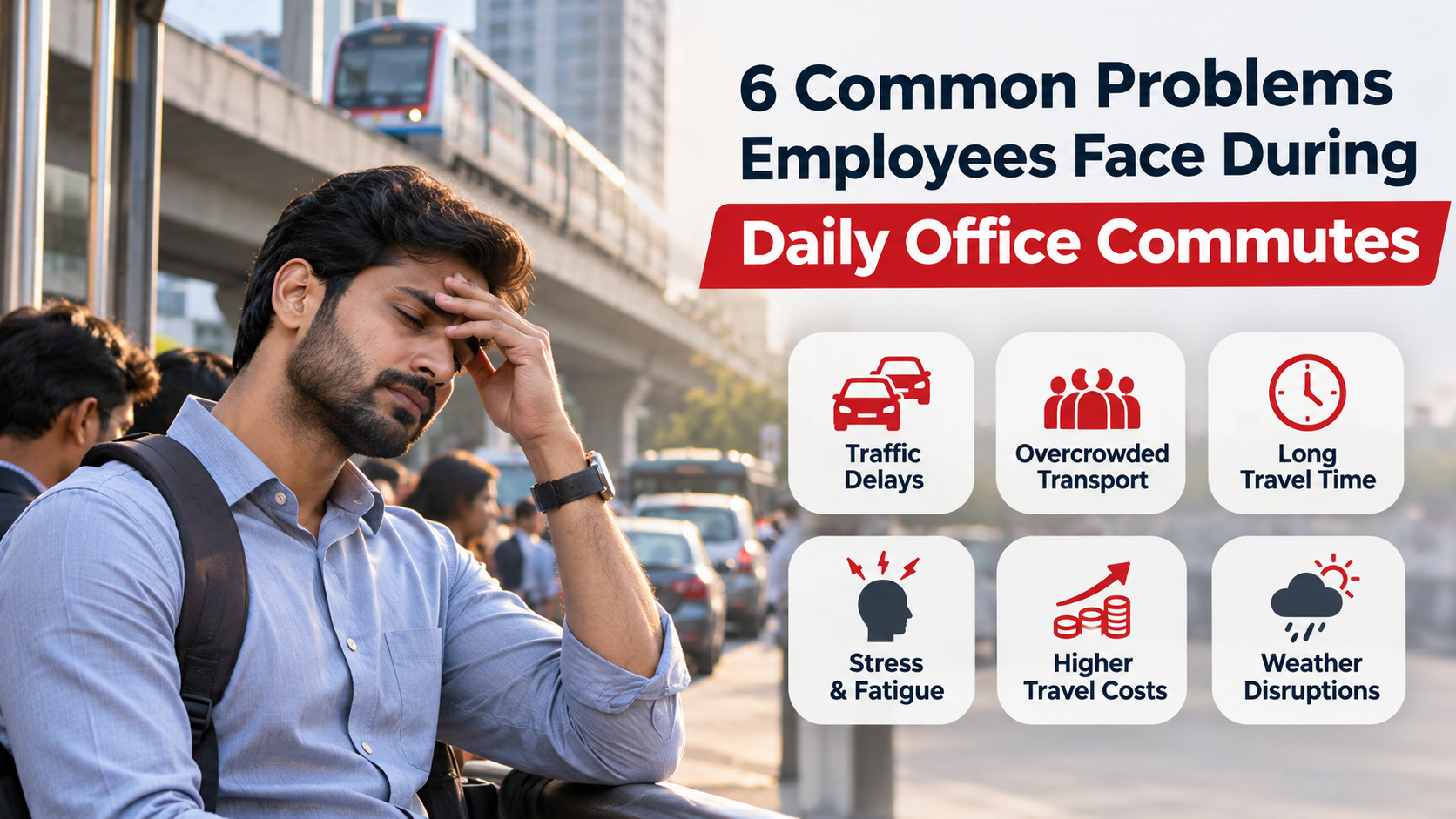
For many people in the paid workforce, the workday is not thought of as beginning upon getting into the workplace. The workday can begin much earlier, often involving a crowded subway carriage, several hours of traffic jams, a long drive in a taxi, or the daily perception of stress in attempting to get to work on time. Commuting, even if it may appear as part of the professional job routine, can have a huge impact on employees’ moods and productivity levels.
Nevertheless, problems associated with daily commuting to the workplace are becoming more and more common due to the rapid expansion of cities, growing traffic congestion, and an increasing number of people commuting to work over longer distances. It doesn’t matter if a person utilizes public transport, drives, uses an office cab, or employs other means of transportation in order to reach the office: arriving at work in a comfortable manner becomes almost impossible.
Table of Contents
Problems Faced by Employees
1. Traffic Jams and Uncertain Travel Times
Traffic jams create one of the most significant issues for commuters. In metropolitan areas, it may seem that people have to cover a small distance, but they may spend even an hour in a bottleneck during the rush hour.
Construction works, accidents, poor traffic management and crowds at peak times create unpredictable travel times. Even if an employee leaves home early, there is no guarantee that he/she is going to reach the workplace on time.
This situation increases the level of stress, especially for people who are obliged to start working at a certain hour, attend important meetings or meet deadlines.
Impacts on employees
- Increases the probability of being late.
- Decreases the amount of time available for personal life.
- Leads to negative emotions and psychological pressure before the working day.
- Makes scheduling difficult.
Solutions
Introduce flexible working hours, hybrid work formats and provide better employee transportation services.
2. Congested Public Transport
For employees who rely on buses, metro and railway transport, congested public transportation is another major commuting issue. During peak hours, when public transportation systems are operating at maximum capacity, passengers often have little space and comfort. After standing for a long period of time or struggling to get onto a train and waiting for buses, commuting can become a cumbersome task.
The problem does not become simpler for those employees who travel long distances or have to connect different means of transportation in order to get to their offices.
Effects of this problem on employees
- causes physical discomfort and tiredness
- heightens stress from commuting
- makes commuting difficult for elderly and disabled persons
- makes employees tired before the start of work
However, by introducing reliable office shuttle services, introducing staggered working hours and supporting public transportation benefits, the situation can be improved.
3. Considerable Expenses for Daily Commute
Transportation expenses pose another issue employees are usually faced with. Costs associated with gasoline, parking fees, subway fares, bus prices, toll charges, and taxi rides accumulate quickly.
For those traveling long distances with work, such expenditures can also cause serious issues. Employees with personal vehicles also need to consider maintenance, insurance, fuel, and repairs.
It’s much more difficult for low-level employees, which makes them think about rent and other expenses.
Impact on employees
- Decreased disposable income.
- Enhanced financial burden.
- Less attractive option of working far away from home.
- Extra expenditures one needs to cope with regularly.
Organizational response to the issue: transport allowance, corporate taxis, car-sharing programs.
4. Absence of Reliable and Safe Transportation
Possessing means of transport does not always ensure that an employee’s commuting experience will be a positive one. Common obstacles include crowded buses, cabs that cannot be found, cancellations announced at the last minute, and unstable transport timetables.
Such an issue may be exacerbated when an employee works night shifts, morning shifts, or irregular hours.
Employee Transportation Safety is one of the major points of concern. Whenever their route includes some dark streets or there is no public transport available during the late hours, employees feeling uncomfortable with traveling alone become more reluctant to go to work. Women, for example, will only be able to accept any working arrangement where transport options are both safe and dependable.
Impact it has on employees
- Creates uncertainty around daily travel plans.
- Increases safety-related concerns.
- Causes delays and unnecessary waiting time.
- Makes night-shift commuting more difficult.
Employers can enhance the commuting experience by providing verified transportation services, GPS-enabled cabs, and emergency assistance during pick-up and drop-off services.
5. Some Physical Strain and Mental Strain
A long commute can result in physical and mental health issues; hours spent in traffic, crowded public transport, or busy roads can lead to employee exhaustion.
Over time, the habitual stress of commuting may lead to back pain, neck pain, headaches, disrupted sleep habits, and other health problems.
The mental aspect is just as important. Worrying about traffic, delays, costs, and getting to work on time can negatively affect a worker’s mood and concentration.
Instead of starting their workday already refreshed, workers often reach their place of employment mentally drained.
Ways it affects the employees
- Less energy and concentration.
- Less motivation to work.
- Higher irritability and stress levels.
- Less time available for sports and relaxation.
In a bid to help their employees with coping with these difficulties, companies should enhance flexibility and offer telework options and wellness programs.
6. Poor Work-Life Balance Due to Long Commutes
The commuting issue that is usually ignored is the impact it has on work-life balance. Those employees who travel for two to three hours every day lose their valuable time, which can otherwise be spent with family, hobbies, sports, or simply relaxing.
If professionals have extended working hours, office and commuting responsibilities make it difficult to keep up with a healthy routine.
Mothers and fathers may struggle to balance their parental duties, while employees who live remotely from downtown districts may find it difficult to socialize and fulfill their commitments.
Ultimately, a daily commute can compromise an employee’s satisfaction at work and may lead to burnout at work.
It Impacts employees
- Leaves less time for family and personal life.
- Affects the daily schedule and healthy lifestyle.
- Increases dissatisfaction with the job.
- Makes employees more inclined to look for jobs close to home.
Companies can help alleviate these issues by introducing hybrid working policies, flexible working hours, satellite offices, or transport programs for employees.
What Can Businesses Do To Make Office Commuting Better?
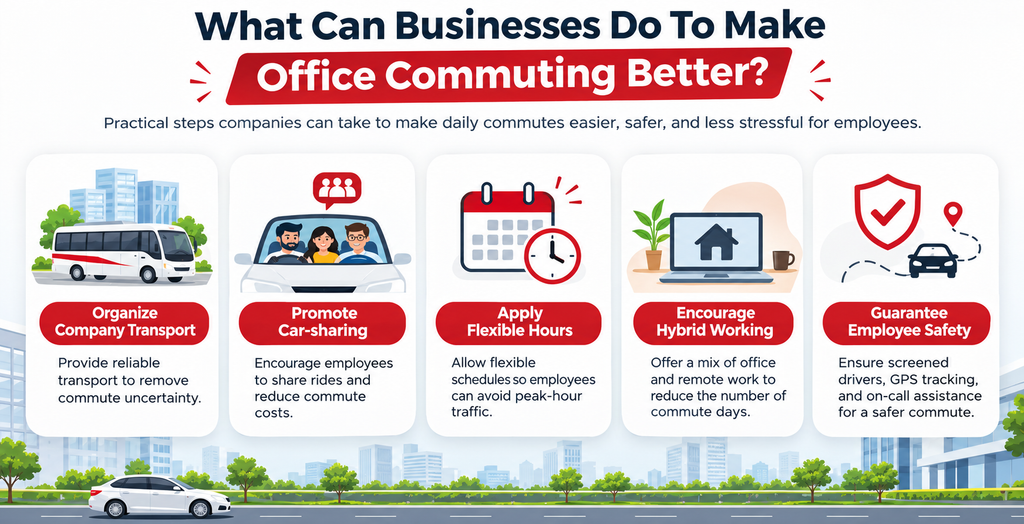
While employees may not always be able to influence traffic conditions or the schedules of public transport, businesses can undertake some practical measures to improve commuting for their staff.
Here are some effective ways for companies to improve the commuting process for their employees:
- Organize company transport: The company may introduce some transport services to remove the unpredictability tied to commuting.
- Promote car-sharing: Using a car-sharing system would help an employee make the commute easier and cheaper.
- Apply flexible hours: Flexible hours of work would allow employees to choose not to pass through crowded routes while commuting.
- Encourage the hybrid way of working: The fewer days an employee is required to be present at work in the office, the less stressful the process of commuting becomes.
- Guarantee the safety of the employees: Making sure that drivers have been screened, GPS is used, and assistance is available if needed improves the security of transportation used for the employees’ commute.
Conclusion
Daily travel to work encompasses more than just arriving at your job. Traveling to work takes a toll on how employees feel and work, as well as how they organize their personal lives.
From being stuck in traffic jams and finding no space on public transport to paying more for travel and feeling overworked and underpaid. The common issues associated with commuting to work negatively affect an employee’s well-being and work efficiency over time.
For companies, it’s essential to acknowledge these challenges as the initial step toward creating a more comfortable work environment for their workers.