
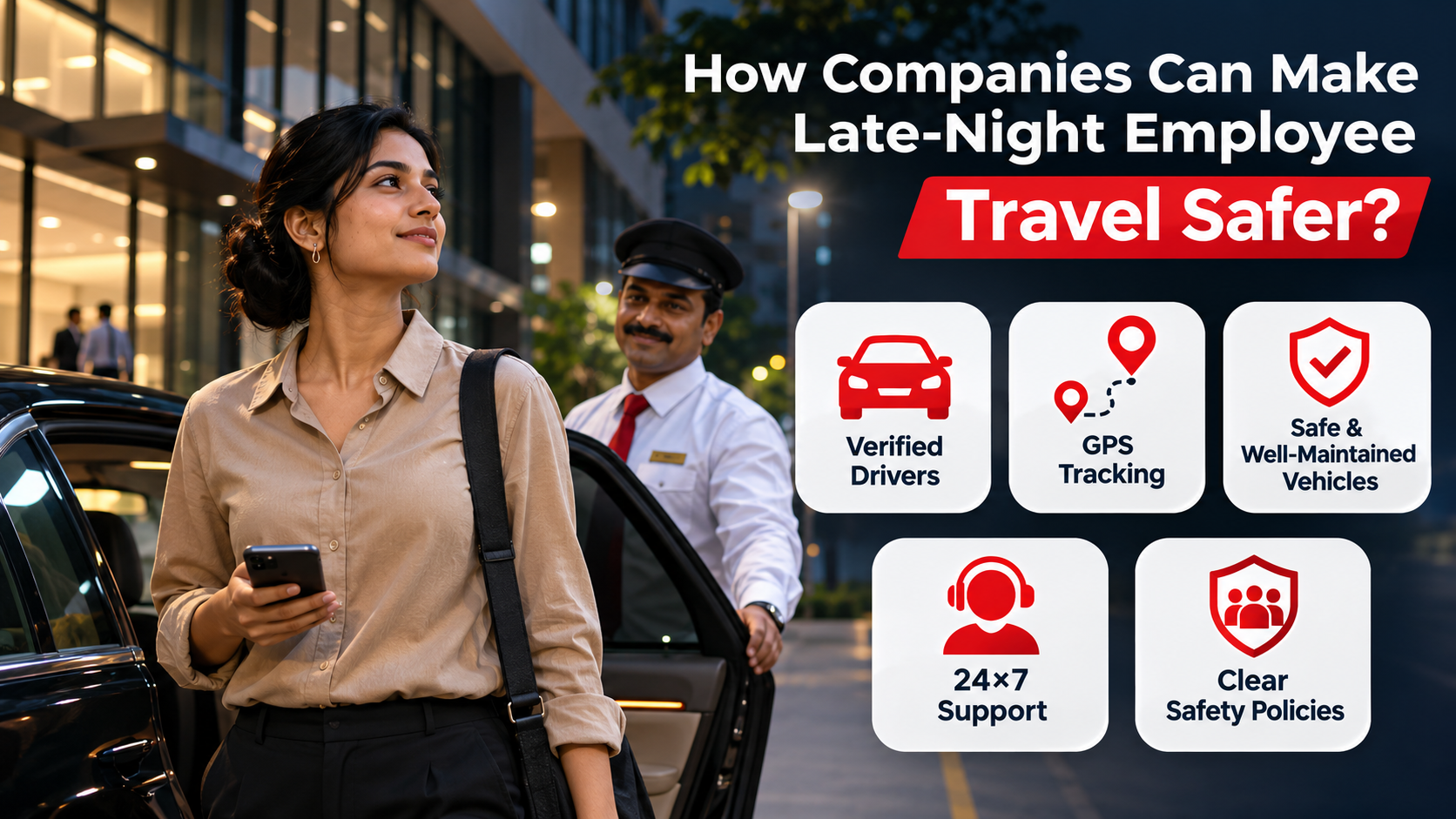
Organizations must always care for the safety of employees heading home after business hours. We all know that organizations still need to deal with staff working the night shift or having to attend meetings or travel after late hours. At times, getting staff home from the workplace is far more concerning than getting the work done itself.
Late-night travel for employees is critical for ensuring workplace safety, especially for companies operating in sectors such as IT, BPO, healthcare, hospitality, manufacturing, and other around-the-clock industries. Travel arrangements that are not planned properly may put employees at risk and force them to end up on unsafe routes, rely on questionable transport, suffer from driver fatigue, and suffer from inability to receive help during emergencies.
The question is: “What can businesses do to ensure safety during late-night travel of their employees?” The answer is simple. It is all about the combination of reliable transport services, technology, strict safety policies, and sincere concern about employees’ lives.
Let us have a look at some useful tips for organizations to follow to create reliable and safe transportation for employees.
Table of Contents
Deliver Dependable Corporate Transportation Services
A prime method of securing employees’ travel safety is to set up a corporate transportation service, allowing their employees to come back home at night without having to arrange their own transport.
Companies are advised to work with trustworthy employee transportation service providers who have their vehicles registered, drivers properly trained, and offer reliable transportation from and to the appointed points. Establishing a corporate transport programmed guarantees the company avoids any uncertainties and prevents it from relying on unknown transport at night.
Companies should also assess the transportation companies based on their safety standards, vehicle maintenance practices, drivers’ background checks, and competence to handle emergencies.
A dependable corporate transport service is not just an advantage; it is a crucial investment in employee safety.
Complete Verification of Driver’s Background
It all starts with a responsible driver. Even the best transport system cannot guarantee the safety of employees if their drivers are not verified and qualified.
The company must ensure that every driver goes through complete background verification prior to being assigned employee transport duties. Identity verification, valid driving license checks, employment history checks and police verification, if required, must be part of this.
Regular training of drivers is very important. Drivers must be conversant with defensive driving skills, traffic rules, passenger safety measures, and general behavior at the workplace as well.
The company must also have a clear policy against distracted driving, speeding, and driving under the influence of alcohol or other substances.
When employees know that their drivers are verified professionals, they can have more trust in the whole transportation process.
Real-Time Vehicle Tracking with GPS
Technology has greatly eased the task of supervising and organizing employee transportation.
With GPS-enabled employee transport systems, businesses have access to information about the location of their vehicles, the routes they have to take, and changes that occur along the way.
Organisations that need to arrange numerous employee pickups and drop-offs benefit from enhanced visibility and control over the transport process.
Here are a few examples of the advantages of GPS-equipped corporate transport:
- Monitoring in real-time: Keep track of employees’ cabs during trips.
- Route monitoring: Identifying unanticipated changes to routes or unnecessary stops.
- Time projections: Let employees get live information about their pickup and drop-off.
- Emergency alerts: Helping the transport manager quickly respond to any irregularities.
- Trip recordings: Keeping logs of trips electronically for the purpose of safety control.
By using an employee transport management system based on technology, companies can minimise uncertainty and react to the situations that arise.
Develop Clear Regulations for Late-Night Transport
Having a well-crafted employee transport policy allows employees to know their duties.
The company ought to set certain rules for employees who are out on the road during late nights and early mornings. There ought to be rules for their cab arrangement, as well as guidelines on how to call for a cab and contact people in cases of emergency.
The company may make sure that cabs are provided for those who have to work late, instead of leaving the employees to their own devices.
Regulations ought to be made regarding what to do if a cab fails to arrive, if the driver has to be replaced, if the cab breaks down, and if the trip must be altered.
In India, organisations should pay attention to the state-specific regulations and safety recommendations.
This leads to less confusion among the employees and makes the provision of safety for employees an obligation for the whole organisation.
Implementing an Exclusive Emergency Response System
No matter how well you prepare, complications may arise when you travel late at night. Some unforeseen events may happen, like the car breaking down, an employee feeling uncomfortable or an unknown route raising security issues.
That is the reason why organizations must have a proper emergency response system.
Employees should be able to reach out to an emergency transport helpline or a control room available 24/7 to get immediate assistance. Emergency contact information must be provided to every employee using transport services.
Comprehensive emergency response systems must have the following features:
- A special contact person to call in case of travel-related emergencies.
- The procedures for escalation of complaints regarding safety.
- Access to platforms that give information about the vehicle and driver in real-time.
- Ability to communicate with emergency services in the area, if necessary.
- The mechanisms for informing trusted emergency contacts whenever needed.
It is necessary for employers to ensure that all these systems are tested on a regular basis instead of considering that emergency preparedness is a one-off experience.
Prioritize Safety First and Schedule Wisely
A faster route is not necessarily the safer route, especially during night-time hours.
Businesses should partner with transportation providers to assess lighted roads, steer clear of secluded areas, and use routes that are accessible and could provide assistance if needed.
Planning routes should take into consideration traffic density and construction activities, detours, and road closures.
Another factor to consider in route planning is the driver’s exhaustion. Excessive operating hours increase the probability of accidents. It is essential for companies to design the transporting schedule in such a way that there are enough periods for driver’s rest.
Keep Employees Informed Throughout the Journey
The aspect of communication is very important in ensuring trust in case of any need for work-related travel during night hours.
Timely notification about designated vehicle, driver schedule, pick up point and approximate time of journey completion should be provided to employees.
Travel firms may provide the required trip planning information via apps for employee transportation, SMS or automatically generated messages.
It is considered useful to perform some form of electronic trip confirmation through which an employee can let his/her employer know that the transport is on the way. Companies may also provide status updates of the journey to people having authority in case of an emergency.
Employees should feel free to share their troubling situation, weird activities or any transportation related concerns.
Consistent Assess and Enhance Transport Safety
Safety in employees’ transportation should always be seen as an ongoing endeavor. This requires constant assessment of the transport safety procedures.
Organizations must make a habit of checking driver behavior, upkeep of the vehicles used, routes for safety, feedback from employees, incident records, and performances of transportation partners.
Conducting employee safety surveys can also provide information about problems that do not manifest in operational reports.
For instance, employees can report locations that are uncomfortable for pick-up, inconsistent behavior of drivers, and triggers for unnecessary delays.
Organizations can therefore make use of this information to improve the transportation policies and standards employed.
A preventative approach enables businesses to foresee and eradicate existing troubles.
Wrapping Up!
Ensuring the safety of late-night travel for employees is more than just a transport issue; it indicates what kind of value a company places on its employees’ wellbeing.
From registered drivers and cabs equipped with GPS to emergency systems and the computerization of transportation policies, every precaution for safety helps to inspire confidence in employee transportation.
The companies that make the effort to ensure the safety of their employees contribute to more than just their safety during the journey; they boost the confidence of their employees and improve their satisfaction at work, thus making themselves better employers.
Employees should not be worried about getting home after leaving the workplace. With investment in the right technologies, companies can make sure that every late-night trip is safe.