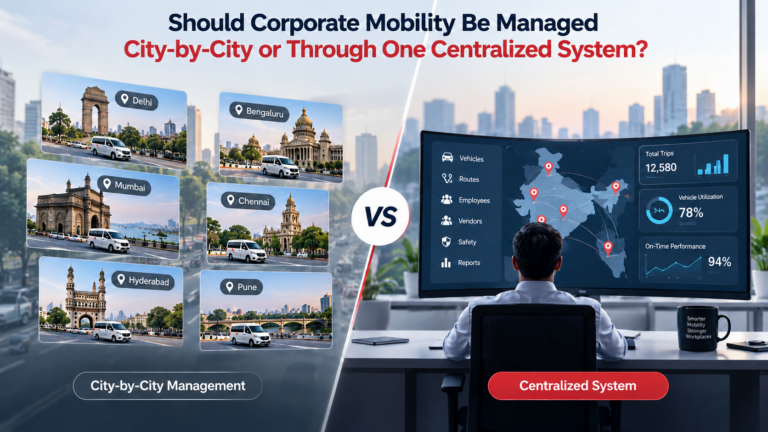
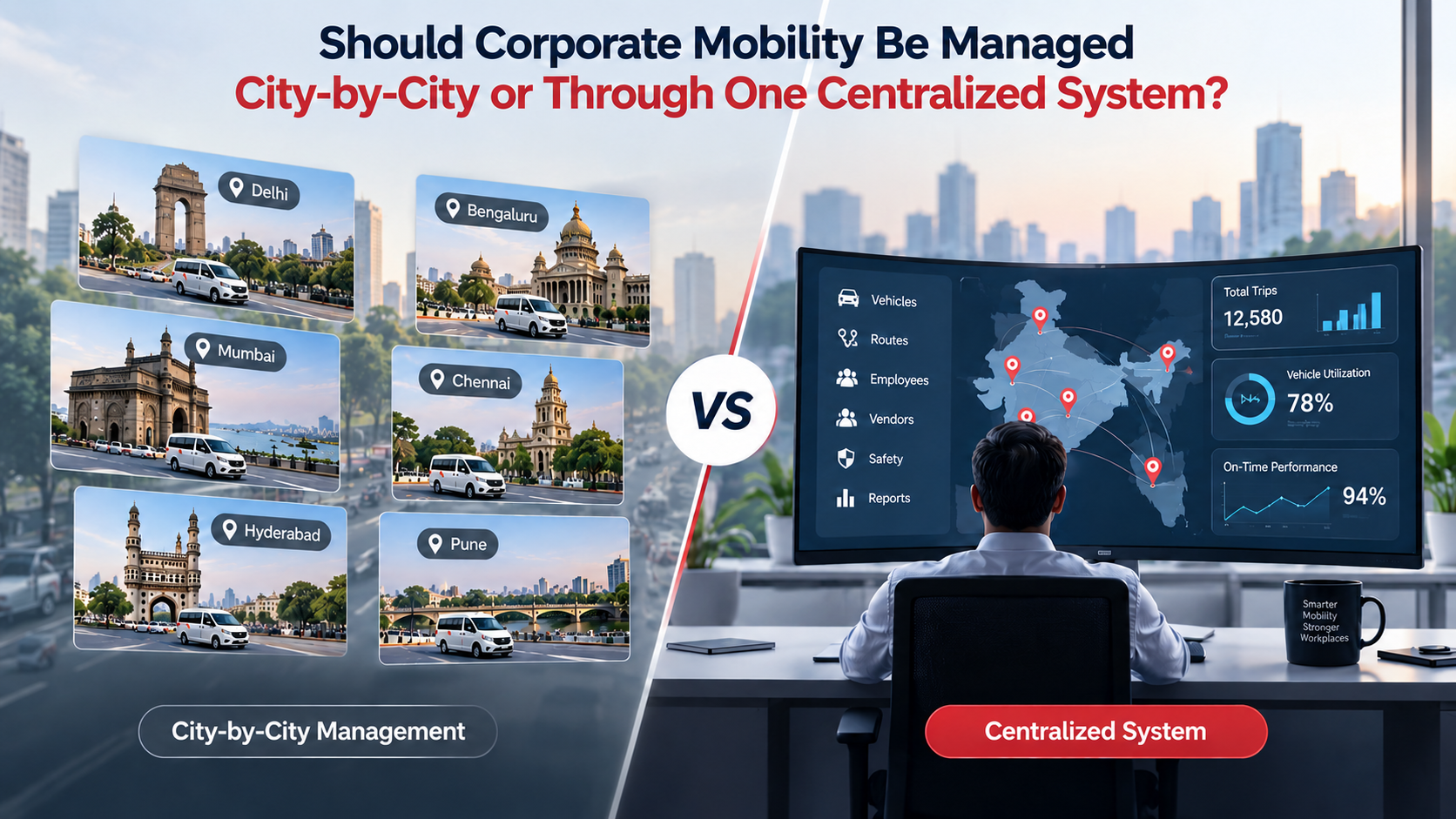
Managing employee transportation gets harder as a business grows across multiple cities. A company in one location may manage employee transport through a small local team. But when the same company has offices in Delhi, Mumbai, Bengaluru, Hyderabad, Pune, Chennai, and other cities, managing every location separately can become difficult.
This raises an important question: Should corporate mobility be managed city-by-city or through one centralized system?
Both approaches have their place. Local teams understand their city’s roads, vendors, employees, and daily travel conditions. A centralized system, on the other hand, can bring data, technology, processes, and reporting together across locations.
For large enterprises, the answer may not be about choosing one approach completely over the other. A combination of centralized corporate mobility management with local execution can provide both control and flexibility.
Table of Contents
What is Corporate Mobility Management?
Corporate mobility management refers to the way an organization plans, operates, monitors, and improves employee transportation and other business travel requirements.
It can include:
- Employee transportation services
- Employee shuttle services
- Office commute management
- Route planning and optimisation
- Fleet management
- Driver and vehicle management
- Pickup and drop-off planning
- Vendor management
- Transportation safety
- Travel data and reporting
- Employee support
- Compliance and billing management
As the number of employees and operating locations increases, these activities become more complex. This is why enterprises need a structured approach to employee transportation management.
What Does City-by-City Mobility Management Mean?
In a city-by-city model, each location manages most of its employee transportation operations independently. The local team may select transportation vendors, plan routes, assign vehicles, manage employees, monitor trips, and handle operational issues.
For example, a company may have one transportation team managing employee transportation in Bengaluru and another team handling the same responsibilities in Mumbai.
This approach gives local teams considerable control over daily operations.
Advantages of Managing Mobility City-by-City
One of the biggest benefits is local knowledge.
A local transportation team may understand:
- Traffic patterns
- Local roads
- Employee travel clusters
- Pickup locations
- Local transport providers
- City-specific regulations
- Common route problems
- Local commuting behaviour
This knowledge can be useful when transportation requirements vary significantly between cities.
A local team can also respond quickly when a road is closed, traffic conditions change, or a local vendor needs to be replaced.
Challenges of a City-by-City Approach
While local control can be useful, managing every city separately can create operational differences. Different locations may use different:
- Transportation vendors
- Technology platforms
- Route planning methods
- Safety processes
- Reporting formats
- Billing systems
- Service standards
This can make it difficult for the corporate team to get a complete picture of the company’s employee transportation operations.
For example, one city may measure vehicle utilisation every month while another may not track it in the same way. Comparing performance then becomes difficult.
There may also be duplicated work across locations, especially when each city manages its own reporting, vendor coordination, and transportation processes.
What is a Centralized Corporate Mobility System?
A centralized corporate mobility system brings key transportation processes under one common framework.
Instead of every city operating independently, the organisation can use a shared system for areas such as:
- Transportation data
- Route planning
- Fleet visibility
- Vendor management
- Employee transportation policies
- Safety standards
- Performance reporting
- Billing and approvals
- Service monitoring
The actual transportation may still be operated locally, but the organisation has a common structure for managing it.
This approach is particularly useful for enterprises with a large and distributed workforce.
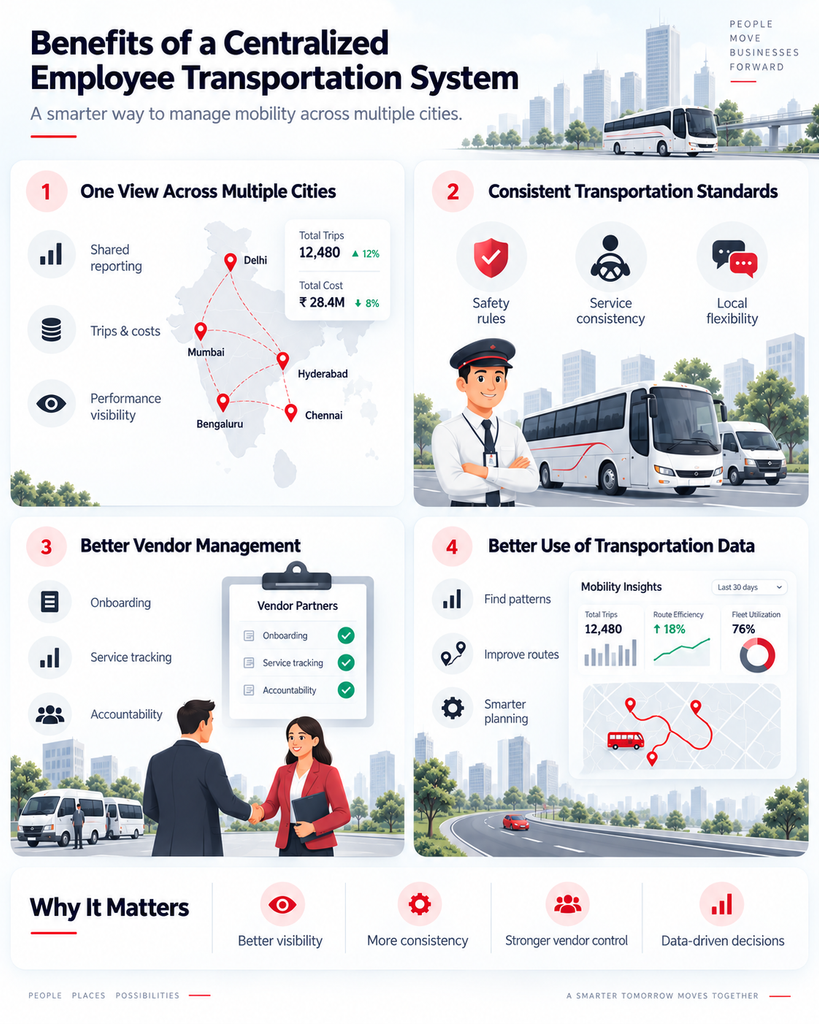
Benefits of a Centralized Employee Transportation System
1. One View Across Multiple Cities
A centralized system can give the corporate team a broader view of transportation operations. Instead of collecting separate reports from every location, decision-makers can access information through a common reporting structure.
They can review metrics such as:
- Number of trips
- Vehicle utilisation
- Route performance
- On-time performance
- Transportation costs
- Employee demand
- Service issues
- Safety incidents
This can make corporate mobility management more data-driven.
2. Consistent Transportation Standards
A centralized model can help enterprises establish common standards across locations. For example, a company can define common expectations for:
- Driver behaviour
- Vehicle safety
- Employee communication
- Emergency response
- Route monitoring
- Vendor performance
- Data reporting
Local teams can then apply these standards according to their city’s specific requirements.
This creates greater consistency without removing local flexibility.
3. Better Vendor Management
Managing several transportation vendors across multiple cities can become complicated. A centralized approach can provide a common framework for vendor selection, onboarding, performance tracking, and evaluation.
The company can monitor whether vendors are meeting agreed service levels and identify areas that need improvement. This can also make it easier to maintain consistent employee transportation services across different locations.
3. Better Use of Transportation Data
Data is becoming increasingly important in corporate mobility.
A centralized system can bring information from different cities into one place. This makes it easier to identify patterns that may not be visible when each city is analysed separately.
For example, the company may discover that certain cities have consistently low vehicle utilisation or that some routes have higher travel times than expected.
These insights can support better route optimisation and fleet planning.
Does Centralization Mean Removing Local Teams?
No, centralization does not necessarily mean that every decision has to be made from a corporate office. In fact, a practical centralized mobility management model can combine central control with local execution.
The central team can manage areas such as:
- Policies
- Technology
- Data
- Reporting
- Governance
- Safety standards
- Vendor frameworks
- Performance measurement
- Local teams can continue to manage:
- Daily transportation operations
- Local route changes
- Employee issues
- Driver coordination
- Local vendor communication
- On-ground challenges
This creates a balance between centralized control and local expertise.
City-by-City vs Centralized Mobility Management
The two approaches can be compared across several areas.
| Area | City-by-City Model | Centralized System |
| Local Knowledge | Strong | Supported through local teams |
| Data Visibility | Often separated | Unified |
| Reporting | Different formats may be used | Common reporting structure |
| Vendor Management | Managed locally | Central framework with local execution |
| Policies | May differ by location | Common standards |
| Route Decisions | Highly local | Data-supported with local input |
| Scalability | Can become complex as cities increase | Easier to manage at enterprise level |
| Technology | Multiple systems may be used | Common platform can be used |
| Governance | Distributed | Centralised |
| Local Flexibility | High | Can be retained through local teams |
Neither model automatically works for every organization. The right structure depends on the number of cities, workforce size, transportation requirements, existing technology, and level of local complexity.
Why a Hybrid Model Can Work for Large Enterprises?
For many large organisations, a hybrid approach can provide a practical middle ground. Under this model, the organisation has a centralized employee transportation management framework, while city-level teams continue to handle local operations.
For example, the central team may define how employee transportation should be managed, what data needs to be collected, and which safety standards must be followed.
The local team can then use this framework to manage transportation based on local road conditions, employee demand, and vendor availability. This approach avoids treating every city exactly the same while still creating a common operating structure.
The Role of Technology in Corporate Mobility
Technology can make centralized mobility management easier.
A modern employee transportation management system can bring information about vehicles, routes, employees, trips, and service performance into one platform.
GPS tracking can provide vehicle visibility, while travel analytics can help organisations understand demand and route performance.
Automated reports can also reduce the need for manual data collection from different locations. With the right technology, corporate teams can get a clearer view of their mobility operations while local teams continue managing daily activities.
What Should Enterprises Consider Before Choosing a Model?
Before deciding between city-by-city and centralized mobility management, companies should consider a few important questions.
How many cities are being managed?
A company operating in two cities may not face the same complexity as one operating in 20 or 50 cities.
How different are the local transportation requirements?
If cities have very different operating conditions, local flexibility may be important.
Is transportation data available in one place?
Without reliable data, centralized decision-making becomes more difficult.
How are vendors currently managed?
Companies with many independent vendors may benefit from a common vendor management framework.
What level of control does the corporate team need?
Some organisations may require stronger central governance because transportation is a significant operational function.
Conclusion
The question of whether corporate mobility should be managed city-by-city or through one centralized system does not have one answer for every enterprise.
City-level management offers strong local knowledge and flexibility. However, as organisations expand, managing every location independently can make data, reporting, vendor management, and service standards harder to control.
A centralized corporate mobility system can provide a common framework, better visibility, consistent standards, and more structured use of transportation data.
For large enterprises, a centralized mobility management model with local execution can bring these advantages together. The central team can focus on technology, governance, data, safety, and performance, while local teams continue to handle the realities of daily employee transportation.
Ultimately, effective corporate mobility is not about choosing between centralization and local expertise. It is about creating a system where technology, data, people, and local knowledge work together to deliver safe, reliable, and efficient employee transportation across every city.