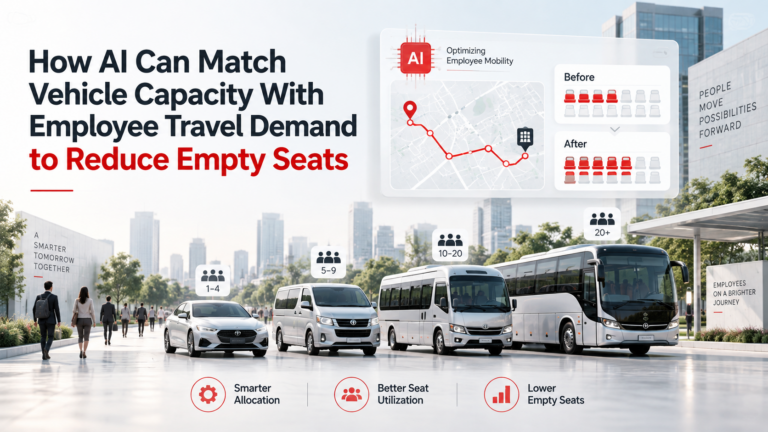
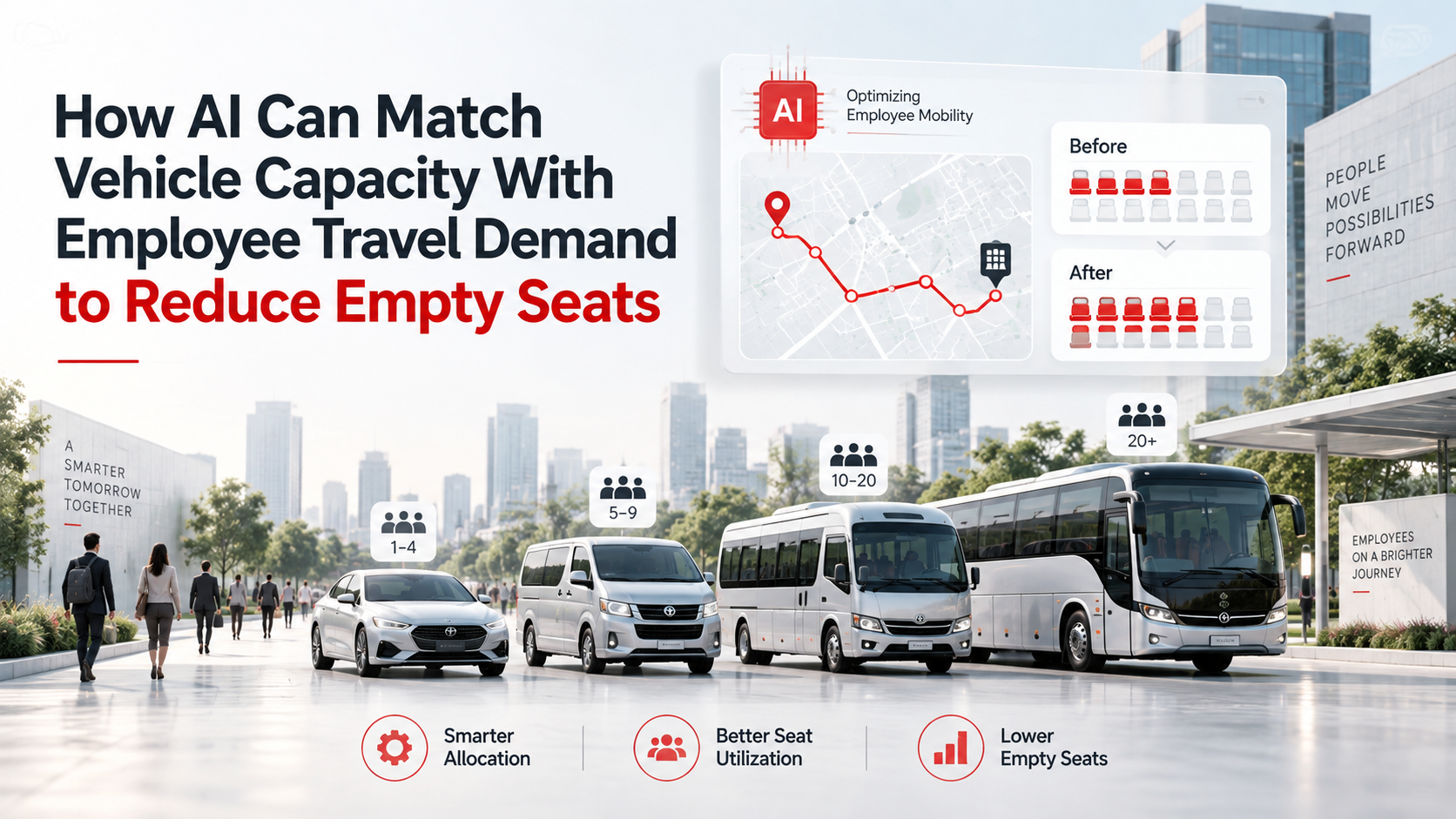
Managing employee transportation is not only about making sure vehicles reach employees on time. For enterprises running daily staff transportation, another important challenge is making sure the available vehicle capacity matches the actual travel demand.
A company may have a large bus running on a route where only a few employees travel on a particular day. On another route, employees may need transportation, but the available vehicle may already be close to full. This difference between vehicle capacity and employee travel demand can make corporate transportation more expensive and less efficient.
This is where Artificial Intelligence (AI) in employee transportation can help.
AI can study travel patterns, employee demand, route information, vehicle capacity, and historical trip data to help companies plan transportation more effectively. By matching the right vehicle with the expected number of employees, businesses can reduce unnecessary empty seats while maintaining a practical and reliable commute service.
Table of Contents
What Is Employee Travel Demand?
Employee travel demand refers to the number of employees who need transportation at a particular time, from a particular area, and towards a particular workplace or destination. This demand is not always the same every day.
For example, an office may have 50 employees travelling on a particular route on Monday but only 30 employees on Friday. Some employees may work from home, take leave, follow hybrid schedules, or change their shift timings.
If the company uses the same vehicle for every trip without considering these changes, the vehicle may have many empty seats.
Understanding these changing patterns is therefore an important part of employee transportation management.
What Causes Empty Seats in Employee Transportation?
Empty seats can happen for several reasons. One common reason is that transportation plans are often created using fixed employee numbers instead of actual daily demand. If a vehicle is assigned based on the maximum number of employees who may travel, it may operate below capacity on many days.
Other reasons include:
- Employees working from home
- Leave and absenteeism
- Hybrid work schedules
- Changes in employee shifts
- Employees using personal transportation
- Different office attendance patterns
- Changes in pickup locations
- Seasonal changes in travel demand
These changes make it difficult for transport teams to manually adjust every route every day. AI can help by analysing these patterns and supporting more flexible transportation planning.
How Can AI Match Vehicle Capacity With Travel Demand?
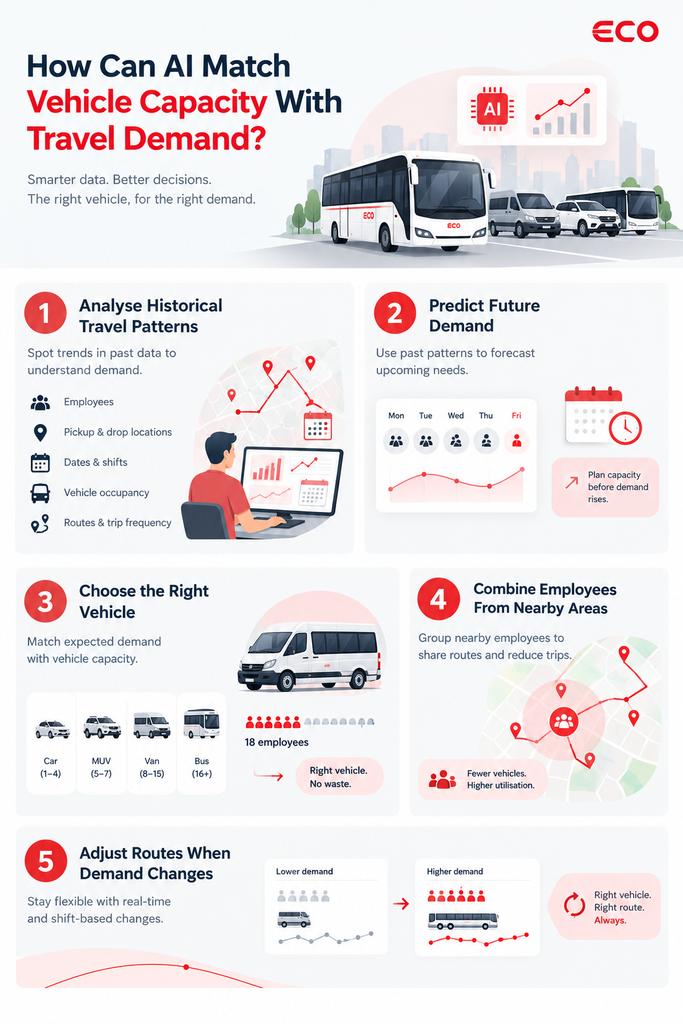
AI can process large amounts of transportation data much faster than manual systems. When historical and current travel information is available, AI can identify patterns and use them to support vehicle allocation.
For example, if data shows that 18 employees usually travel on a particular route on a specific shift, the system can help transport managers consider a vehicle that is suitable for that demand instead of automatically assigning a larger vehicle.
Similarly, if demand is expected to increase on another route, the system can help identify where additional capacity may be required.
The objective is simple: match vehicle capacity as closely as practical with expected employee demand.
1. Analysing Historical Travel Patterns
AI can study historical transportation data to identify recurring patterns.
It can look at factors such as:
- Number of employees travelling
- Pickup locations
- Drop-off locations
- Travel dates
- Shift timings
- Vehicle occupancy
- Route distances
- Trip frequency
- Employee attendance patterns
Over time, this information can show when demand is usually high or low.
For example, if a route regularly has low occupancy on certain weekdays, the company can review whether a smaller vehicle or a different route structure would be more suitable.
This type of data-driven employee transportation planning can help reduce unnecessary vehicle capacity.
2. Predicting Future Employee Transportation Demand
One of the useful applications of AI is demand forecasting.
AI systems can use previous travel patterns to estimate future transportation requirements. The prediction will not always be perfect because employee attendance can change, but it can provide a useful planning reference.
For example, if historical data shows that employee attendance is usually lower on Fridays, the transportation team can take this expected demand into account when planning vehicles. Similarly, if a particular shift consistently has higher demand, the company can plan additional capacity accordingly.
This approach can be especially useful for enterprises managing a large number of daily employee trips.
3. Choosing Vehicles Based on Expected Demand
Different vehicles offer different seating capacities.
A transportation operation may include cars, MUVs, vans, shuttles, buses, or other vehicle types. Assigning the right vehicle depends on the number of employees travelling, the route, and operational requirements.
AI can help compare expected demand with available vehicle capacity. If demand is low, a smaller vehicle may be considered. If demand is high, a larger vehicle may be required.
This can help businesses avoid situations where a large vehicle regularly travels with only a small number of passengers.
4. Combining Employees From Nearby Areas
AI can also support route optimisation by identifying employees who live or travel in nearby areas. Instead of treating every employee as a separate trip, transportation planning systems can identify groups of employees who can potentially share a route or pickup point.
For example, if employees from several nearby neighbourhoods are travelling to the same office around the same time, the system can help transport planners explore whether they can be served through a common route.
This can improve vehicle utilisation and reduce unnecessary trips. Any such change should still consider reasonable travel time, safe pickup points, accessibility, and company transportation policies.
5. Adjusting Routes When Demand Changes
Employee transportation demand can change during the day or from one shift to another. AI-enabled transportation systems can help identify these changes and support route adjustments.
For example, if the expected number of passengers on one route falls significantly, transport managers can review whether the existing vehicle and route are still appropriate.
Likewise, if another route experiences increased demand, additional capacity may need to be considered. This makes employee transportation more flexible than a completely fixed route model.
How Reducing Empty Seats Can Improve Fleet Utilization?
Empty seats do not always mean that a transportation programme is poorly managed. Some unused capacity is often necessary because demand can change and companies may need a certain level of flexibility.
However, consistently low occupancy can indicate that vehicle capacity is not being matched closely enough with demand.
Improving fleet utilisation can help companies make better use of their existing transportation resources.
When vehicles are assigned according to realistic demand, companies may be able to reduce empty kilometers, avoid oversized vehicles on low-demand routes, and make better use of available fleet capacity.
The exact financial or operational impact will depend on factors such as vehicle costs, routes, employee demand, fleet structure, and operating policies.
AI Does Not Replace Human Decisions
Although AI can process large amounts of data, it should not be the only factor used to make transportation decisions.
There are situations where a larger vehicle may be required even when current demand is lower. Companies may need to maintain backup capacity, support specific employee groups, meet safety requirements, or handle unexpected changes in attendance.
Transport managers also understand practical factors that may not be fully visible in the data. For this reason, AI is best used as a decision-support tool for employee transportation to help the team to understand demand and evaluate possible options.
Human oversight remains important when making final route and vehicle decisions.
What Data Is Needed for AI-Based Fleet Planning?
The quality of AI-based recommendations depends heavily on the quality of the data available. Useful information can include:
- Employee travel requests
- Historical trip data
- Vehicle capacity
- Actual vehicle occupancy
- Pickup and drop-off locations
- Shift timings
- Employee attendance patterns
- Route distance
- Travel time
- Vehicle availability
- Route performance
The more consistent and accurate the data, the more useful the analysis can become. Companies should also handle employee location and transportation data responsibly with applicable privacy requirements and internal policies.
AI and the Future of Employee Transportation Management
As businesses move towards more data-driven operations, AI can become an important part of corporate transportation management.
Instead of planning routes and vehicle allocation only through fixed schedules, companies can use technology to understand changing employee demand.
AI can help transport teams answer practical questions such as:
- How many employees are expected to travel?
- Which routes may have higher demand?
- Where is vehicle capacity being underused?
- Which vehicle type may be suitable for a particular route?
- Can nearby employees be grouped into a shared route?
- Where could transportation capacity be adjusted?
These insights can help companies build a transportation system that responds more closely to actual employee travel requirements.
Conclusion
Matching vehicle capacity with employee travel demand is an important part of efficient employee transportation management. When vehicle capacity is significantly higher than actual demand, businesses may end up carrying unnecessary empty seats. At the same time, insufficient capacity can create overcrowding and a poor employee experience.
AI can help bridge this gap by analysing historical travel patterns, forecasting demand, identifying occupancy trends, supporting route optimisation, and helping transport teams evaluate suitable vehicle capacity.
The goal is not simply to fill every seat. It is to create a transportation system where vehicle capacity, employee demand, route planning, and employee convenience work together.
For enterprises managing large employee transportation operations, combining AI with reliable travel data and human oversight can support better fleet utilisation, more flexible route planning, and a more efficient approach to corporate mobility.