Choosing the appropriate employee transportation service partner is increasingly becoming an important decision for organizations operating in many cities, across wide campuses, and with shift schedules. Today, businesses are not only looking for someone who can help them to organize their transport. Now, they want a partner who can collaborate with them in evaluating fleet availability, ensuring employee safety, maintaining route efficiency, using the most up-to-date technologies, promoting sustainability, providing services across a wider area, and managing the fleet at scale.
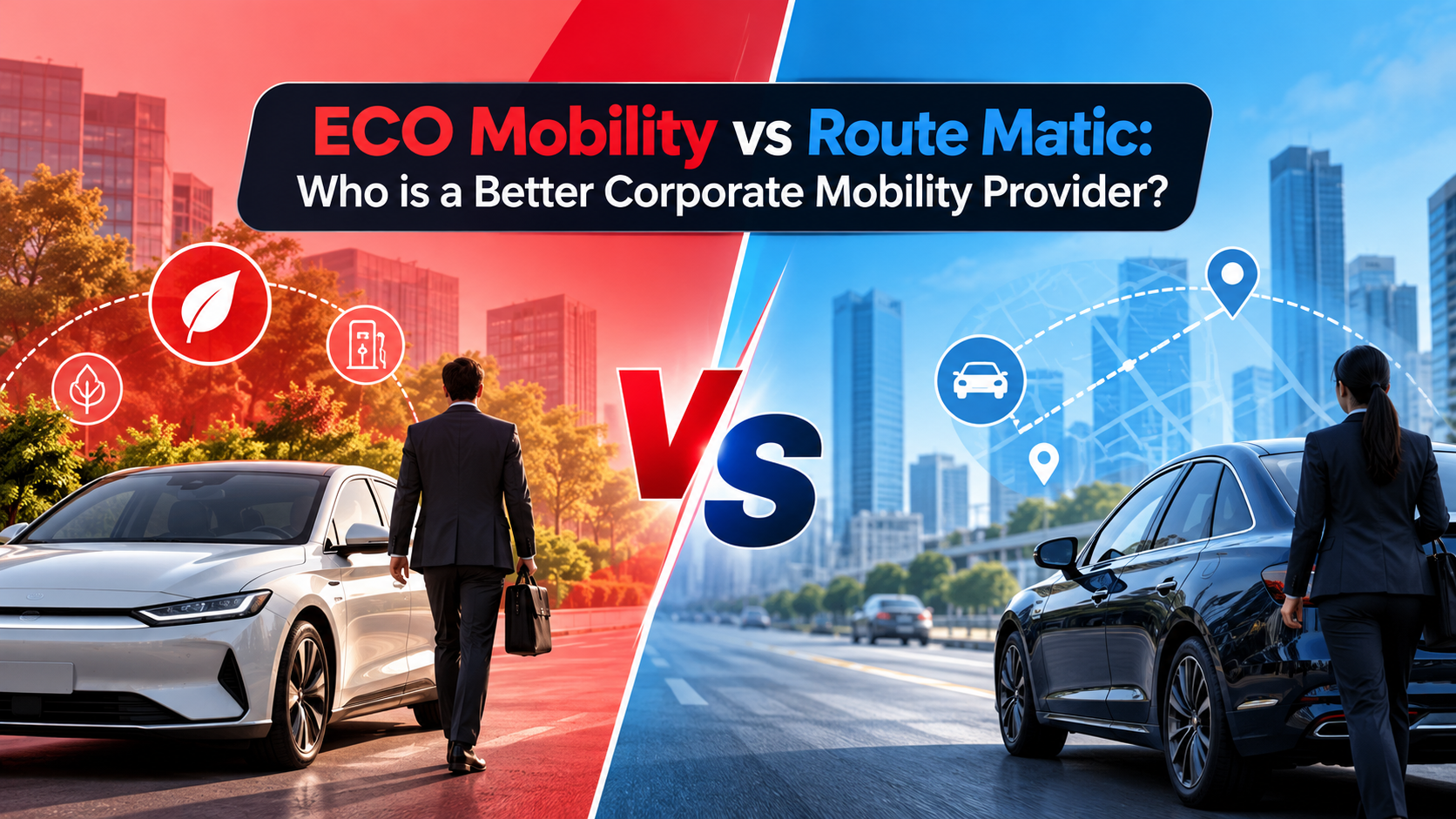
Both companies operate in the corporate mobility and employee transportation market but have different approaches. ECO Mobility is focused on corporate mobility, chauffeur services, and the creation of a huge transportation network based on partnerships. RouteMatic has built its business around innovation in employee transportation, including dynamic routing, fleet operations, and technology use.
The purpose of the comparison of the two organizations is not to find out which of them is better. Instead, it studies the differences between the companies in their business models, technologies, fleet management, sustainability, geographical coverage, and use cases.
Table of Contents
ECO Mobility vs RouteMatic: At a Glance
| Area | ECO Mobility | RouteMatic |
|---|---|---|
| Primary focus | Corporate mobility, chauffeur-driven rentals and employee transportation | Technology-led employee transportation services |
| Operating approach | Asset-light, partner-driven network | Technology combined with managed fleet operations |
| Geographic footprint | Broad presence across 151 cities in India and 100+ countries worldwide | Concentrated presence in major technology and business hubs in India |
| Technology focus | Dispatch, tracking, scheduling, and operational management with SaaS service for route planning | Dynamic routing, scheduling, automation and analytics |
| Fleet approach | Multi-category vehicle network through partners and a thoughtfully curated fleet solution that is designed to serve every enterprise commute scenario | Managed fleet with significant emphasis on EV adoption to promote sustainability along with a hybrid and tech-driven fleet approach |
| Sustainability approach | Supports multiple vehicle categories, including EV and executive Sedans. | Strong focus on EV-based employee commuting and emissions reporting |
| Corporate structure | Publicly listed company | Privately held, venture-backed technology |
The above table provides a starting point, but the differences become clearer when each company’s operating model is examined in more detail.
Business Model: ECO Mobility vs RouteMatic
One major distinction that has been observed in the comparison of ECO Mobility vs RouteMatic is the operational strategy each entity follows in transportation.
ECO Mobility has a variety of fleets for every travel requirement, which includes owned as well as asset-light models. ECO Mobility collaborates with a variety of transportation vendors and operators, thus making it possible to obtain vehicles and drivers from various locations.
ECO Mobility covers a range of corporate mobility requirements, including executive transportation, airport transfers, corporate events, vehicle leasing, and employee transportation, event transportation. This variety of services implies that ECO Mobility can be used for purposes other than employee transportation.
RouteMatic employs a distinct strategy here, as it relies on TaaS, which stands for transport-as-a-service. Instead of seeing software as a separate good, the company combines its tech platform with transport services.
This is important because the transportation of employees might involve hundreds or even thousands of trips on a daily basis. A platform can provide data and automation features, but it is the fleet and operations management that make it possible to implement the plans in reality.
Technology and Route Optimization
Companies in employee transportation management actively utilize technology in their operations to boost efficiency, improve routes, and solve evolving employee transport needs.
RouteMatic’s employee transportation solutions revolve around technology, offering features like real-time dispatch, shift management, employee transportation management systems, and route optimization. Their employee transportation solution is beneficial for companies with ever-changing shift schedules.
ECO Mobility, however, adopts a technology-agnostic approach to ensure the use of the most appropriate technological solutions to address its customers’ needs. The company utilizes technology to manage the transport process, track vehicles, manage dispatch, plan routes, and coordinate services, while remaining flexible in terms of operations, customers’ systems, and business processes.
For organizations with fluctuating employee schedules, effective technology integration can help manage daily changes, improve vehicle utilization, and minimize unnecessary travel. However, the effectiveness of these solutions also depends on operational expertise, network strength, and the ability to manage transportation requirements across different locations.
The key distinction, therefore, is not whether technology is used, but how it is incorporated into the overall service delivery model. While RouteMatic emphasizes technology as a central component of its transportation management offering, ECO Mobility emphasizes a flexible, technology-agnostic approach that combines appropriate technology with operational expertise and a strong mobility network to deliver efficient, scalable, and reliable employee transportation solutions.
Fleet Network and Geographic Coverage
Geographic reach can be a key aspect for organizations that have personnel, customers, or business activity all over India.
ECO Mobility created a large decentralised transport network that works nationwide and across the globe. The fact that the company makes use of partners allows it to work only with local market players and utilize different vehicle types.
In contrast to ECO Mobility, RouteMatic has a narrower presence and operates mainly in technology and business cluster areas. The approach they take implies that a lot of effort is made in managing employees’ transport needs in locations where firms have set up proper shifts and commute schedules.
Therefore, the question is not one of making a choice about the best possible method available. The only thing that matters here is understanding the operating geography of the company.
In fact, an organization with offices in many cities of India would pay more attention to the breadth of the network, while a large transnational company located in one of the largest business or tech clusters would focus on other factors.
Employee Transportation and Shift Management
The complexities of employee transport grow manyfold for companies that operate through many shifts in various places, especially when nighttime, early morning, or odd-hour operations are involved.
IT companies, BPOs, global capability centres, and shared services companies can have employees working through several shifts, making an intricate transport system necessary for these companies.
Technology is the main instrument in helping companies successfully transport employees, as it allows businesses to employ innovative route and scheduling methods to organize and manage employee transportation throughout different shifts and changing needs.
ECO Mobility is another major employee transportation service vendor that involves employees with its unique transport network and capabilities. The service offered by ECO Mobility covers management of commuting for employees working through different shifts.
In addition to both technology-managed and operationally managed transport systems, management of shift transport involves safety issues as well. Proper management of trips and drivers, communication, and the escalation process are important at times when employees travel during late nights or early morning hours.
Thus, the key point that companies must pay attention to while evaluating the employee transportation providers is the ability of a provider to handle more complicated situations involving shifts, transport schedules, employee demand, and safety requirements at scale.
Safety and Compliance
Employee transport is not simply a logistics exercise. Safety, compliance and accountability are major considerations, particularly for organizations transporting employees during late-night and early-morning shifts.
Technology can support this area by creating structured processes for driver management, trip tracking, route monitoring, alerts and employee communication.
RouteMatic incorporates automated processes into its transportation platform, with particular attention to employee commute management and safety requirements.
ECO Mobility is responsible for the transportation needs of both corporate clients and personnel with its broad operational system encompassing all fields of logistics, with a technology-agnostic approach to service and safety. It does not stick to one technology-based platform, but applies all possible solutions required to ensure its key safety processes, such as chauffeur identification and training, vehicle tracking with GPS, trip data monitoring, and round-the-clock support. The company has had a long-term collaboration with transport providers, who help the company to adapt the processes to the particularities of working in a given area.
For organizations evaluating providers, it is useful to look beyond marketing claims and assess practical factors such as driver verification, emergency response procedures, trip visibility, escalation mechanisms, compliance documentation and service-level agreements.
EV Adoption and Sustainability
Sustainability is gradually becoming a significant aspect of corporate transportation planning, especially since companies strive to meet emissions reduction goals.
RouteMatic is committed to promoting electric mobility-based transportation for employees. This model is based on technology, and it also has the potential to provide organizations with data that will help analyse transportation emissions for further use in sustainability technologies.
This is especially valuable for companies having proper ESG programs or Scope 3 emissions reduction objectives.
Moreover, ECO Mobility covers a wider spectrum of transport vehicles complying with various corporate rental needs, including executive transport, airport transfers, EVs, and employee mobility. This means that both companies have different approaches towards fleet sustainability.
For those companies beginning to implement electric transport systems for employees, it is important to take into consideration the efficiency of transport implementations.
Data, Analytics and Transportation Visibility
Modern employee transportation programs produce lots of operational data. This consists of data about routes, vehicle usage, employee demand, journey time, cancellations, occupancy, and transportation costs.
RouteMatic’s technology-first approach makes data analysis and data visibility closer to the centre of the transport management process. Businesses can use this knowledge to find inefficient routes, understand demand patterns, and make necessary changes in transportation planning.
ECO mobility uses digital solutions to execute transport operations such as trip management and tracking. However, its wider value proposition is closely linked to its network and operational service strengths.
While companies are comparing employee transport providers, the following questions should be asked concerning the available data: what data is available, how frequently it is updated, whether reports can be tailored according to the needs of the client, and if transportation teams can easily process this data into operational decisions.
Service Portfolio
Another important difference in the ECO Mobility vs RouteMatic discussion is the range of services offered.
ECO Mobility has a broad corporate mobility portfolio. Its services can cover chauffeur driven rental service, airport transfer, corporate events, executive travel and employee transportation. This makes its offering relevant to companies that want to consolidate multiple business transportation requirements with a single mobility partner.
RouteMatic is more specifically positioned around employee transportation and technology-enabled commuting. Its offering is therefore closely aligned with organizations where employee transportation is a major operational function rather than an occasional corporate travel requirement.
Why Consider ECO Mobility?
If you are in search of a partner for corporate mobility, then ECO Mobility should make it to the top of your list. It has an enormous range of transport facilities combined with a strong operational structure.
What makes ECO Mobility a viable choice is:
- Extensive geographical presence: This company has created an operating network capable of addressing transportation needs across many major cities.
- Integrated mobility solutions: It offers all passenger services, corporate vehicles with a chauffeur, business trips, premium class rental cars, airport transfers, and travel services through the same supplier.
- Technology-agnostic approach: The flexibility to leverage suitable technology solutions for transportation management, tracking, dispatch, and route optimization according to client-specific requirements.
- Flexible and scalable business model: It enables the support of different transportation needs regardless of geography, number of employees, and the needs of the businesses that cooperate with the company.
- Strong operating network: The company has developed partnerships with various transport companies, which allows it to provide its services throughout the country.
- Focus on safety: Transportation services are provided according to a well-established system of verification and training of chauffeurs, trip verification, etc.
- Corporate mobility expertise: Experience serving enterprise clients with varied transportation requirements, from daily employee commutes to executive and business travel.
What distinguishes ECO Mobility is its ability to bring diverse transportation requirements together within a single mobility ecosystem. Rather than limiting its focus to one category of transportation or a particular technology platform, ECO Mobility leverages its experience in operations, wide-ranging services, and flexibility of technology to meet the needs of its business customers.
If you are searching for a mobility partner to meet both daily employee transportation needs and general transportation needs of your business, ECO Mobility adopts a flexible approach that offers various services, large-scale operations, and custom-fit solutions.
ECO Mobility vs RouteMatic: What Should Businesses Evaluate?
There is no single metric that can determine the right transportation provider for every company. Instead, procurement and administration teams should assess several factors before making a decision.
These questions can create a much clearer basis for comparison than simply looking at company size or technology features.
Conclusion
The ECO Mobility vs RouteMatic comparison highlights two different approaches to corporate transportation.
ECO Mobility has developed a broad mobility business around an asset-light partner network, corporate transportation services and extensive geographic reach. Its portfolio extends beyond employee commuting into executive mobility, airport transfers, events and other business transportation requirements.
In contrast, RouteMatic has formulated its value proposition on the principle of technology-backed employee transport. Some examples of RouteMatic’s “strong suits” are dynamic routing, automated scheduling, operational insights, data analytics, and sustainable commuting (which includes using electric vehicles).
Therefore, in conclusion, choosing between ECO Mobility and RouteMatic is more a matter of matching the transportation model to the operational needs of the business rather than finding an overall winner. The most effective benchmarking criteria, therefore, should focus on geography, number of employees, complexity of shifts, fleet requirements, technology demands, sustainability objectives, and scalability.