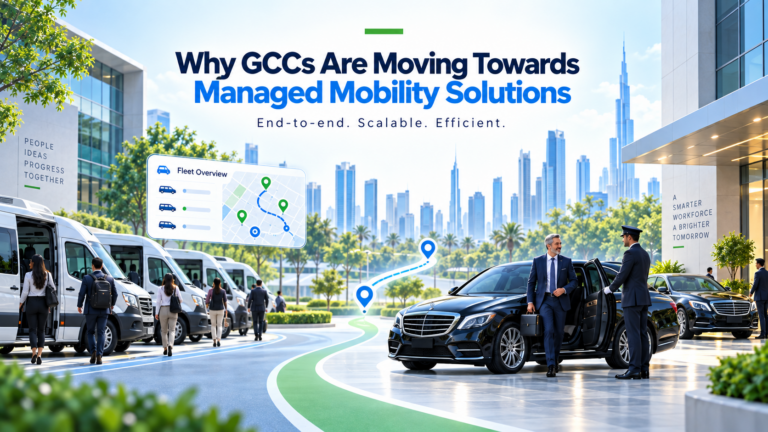
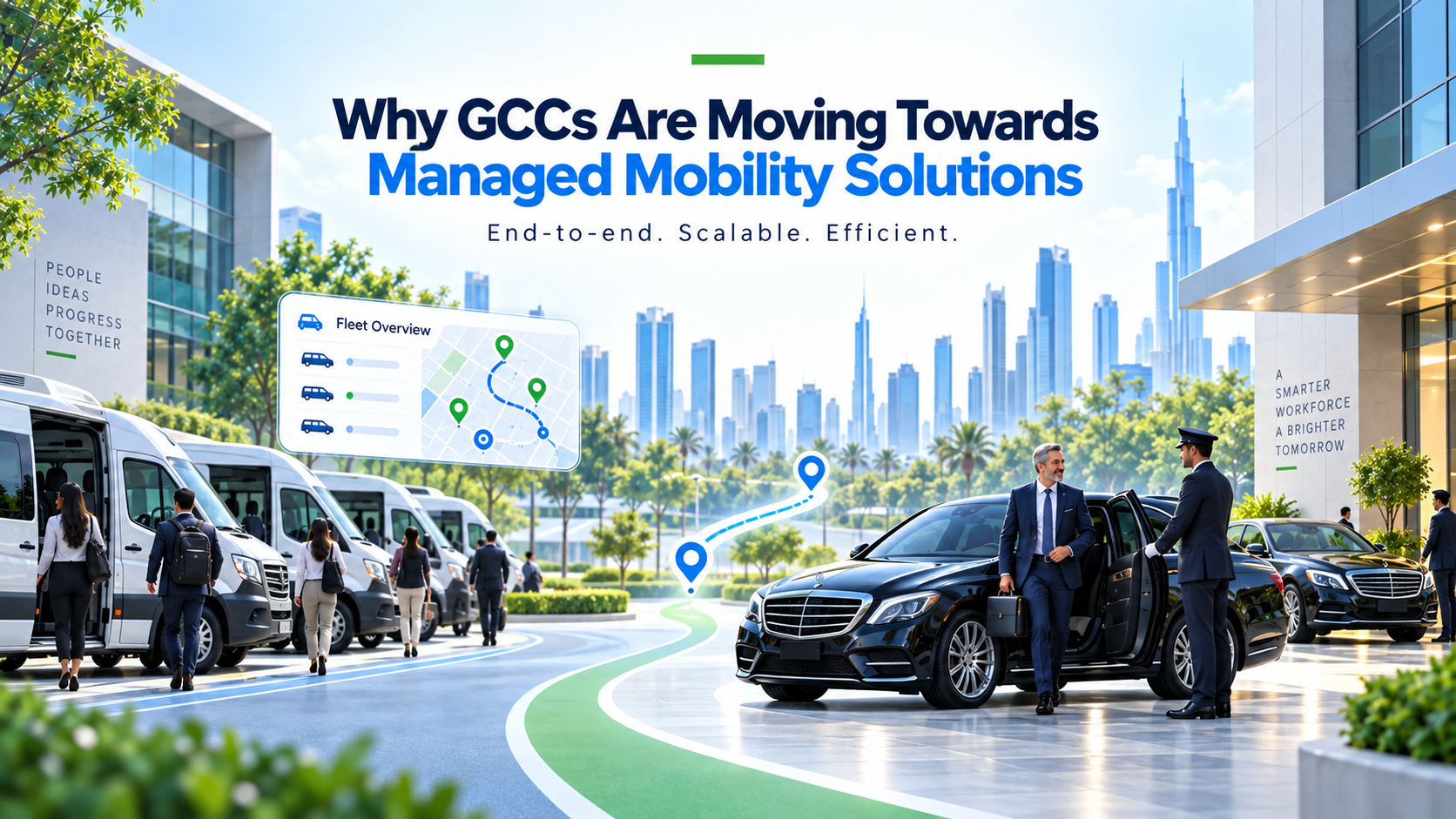
Global Capability Centers (GCCs) have changed significantly over the past few years. What started as support centers for global businesses has evolved into strategic hubs for technology, research, finance, analytics, operations, and innovation.
As GCCs continue to grow, their employee mobility needs are becoming more complex. Managing office transportation across multiple shifts, locations, vendors, and employee requirements can quickly become a full-time operational challenge.
This is one of the key reasons why more GCCs are looking at end-to-end managed mobility solutions instead of managing transportation through multiple vendors and internal teams.
But what exactly is driving this shift, and what does it mean for GCCs?
Table of Contents
What are End-to-End Managed Mobility Solutions?
An end-to-end managed mobility solution covers the complete employee transportation lifecycle.
It goes beyond simply providing cars, buses, or drivers. A managed mobility provider can take care of planning, operations, technology, safety, vendor coordination, employee communication, and reporting.
Depending on the GCC’s requirements, the solution may include:
- Employee transportation services
- Employee pickup and drop services
- Shift transportation management
- Route planning and optimization
- Fleet and driver management
- GPS-based vehicle tracking
- Employee transport booking
- Transport helpdesk support
- Safety and compliance management
- Vendor management
- Trip monitoring
- Transportation analytics and reporting
The idea is to bring these different functions together instead of managing them as separate activities.
Why is GCC Transportation Becoming More Complex?
GCCs often operate around the clock. Employees may work during regular business hours, early mornings, late evenings, weekends, or night shifts.
A large GCC may also have employees traveling from different parts of a city to one or more office locations.
This makes employee transportation a dynamic operation.
Routes have to be adjusted when employees join or leave. Vehicles need to be added when demand increases. Pickup points may need to be changed. Drivers have to be scheduled according to different shifts, while safety procedures need to be followed consistently.
When these activities are managed manually or across multiple vendors, the transportation team can spend a significant amount of time coordinating day-to-day operations.
An employee transportation management solution can bring these activities into one structured system.
1. One Partner Can Simplify Transportation Management
One of the biggest reasons GCCs consider managed mobility is operational simplicity.
In a traditional setup, a company may have separate vendors for vehicles, drivers, technology, helpdesk services, and other transportation activities. Managing these relationships can become complicated as the organization grows.
With an end-to-end model, a mobility partner can coordinate multiple aspects of the operation.
For the GCC’s facilities, administration, HR, or workplace teams, this means fewer operational touchpoints and a more centralized way of managing transportation. It also creates clearer accountability because transportation performance can be monitored through one managed framework.
2. Better Visibility Into Transportation Costs
Transportation is a significant operating expense for many large organizations. However, understanding where that money is being spent can be difficult when different vendors and processes are involved.
A managed mobility solution can provide consolidated information about trips, routes, vehicles, utilization, and operational expenses.
For example, transportation data may reveal that some routes consistently have low utilization while others regularly require additional vehicles.
With this information, organizations can review their routes and vehicle requirements based on actual demand.
This can support employee transportation cost optimization and help GCCs make more informed decisions about their mobility programs.
3. Technology is Making Mobility Smarter
Technology has become an important part of modern employee transportation.
An employee transportation management system can connect employees, drivers, vehicles, transport teams, and administrators on a common platform.
Depending on the solution, features can include:
- Real-time vehicle tracking
- Automated trip allocation
- Route optimization
- Digital attendance
- Employee notifications
- Driver and vehicle information
- Trip monitoring
- Automated reports
- Transportation dashboards
For employees, this can mean better visibility into their daily commute. Whereas for administrators, it can reduce manual coordination and provide access to real-time transportation information.
4. Safety Remains a Major Priority
Employee safety is one of the most important considerations for any GCC running transportation services.
This is especially relevant when employees travel during late-night or early-morning shifts.
A structured employee transportation solution can support safety through GPS tracking, driver verification, trip monitoring, emergency response procedures, and defined escalation processes.
For organizations, having standardized processes can also make it easier to monitor whether transportation partners are meeting established safety requirements.
Technology cannot eliminate every transportation risk, but it can give companies greater visibility and faster access to information when an issue occurs.
5. Managed Mobility Can Scale With GCC Growth
GCCs are often designed for growth. A center that starts with a relatively small workforce can expand significantly over time.
Transportation needs grow along with the workforce.
More employees can mean more routes, additional vehicles, new pickup locations, and increased demand during peak shifts.
This is where managed mobility services can offer flexibility.
A transportation partner can scale vehicle capacity and operational resources according to changing requirements. This can be particularly useful when a GCC opens a new office, expands its workforce, introduces additional shifts, or enters a new city.
Instead of building a new transportation operation every time the business expands, the organization can scale an existing mobility framework.
6. Employee Experience Is Becoming Part of Mobility
For employees, transportation is part of their everyday work experience.
A delayed vehicle, unclear pickup information, or difficulty reaching the transport helpdesk can create unnecessary frustration.
Modern corporate mobility solutions can improve communication throughout the employee journey.
Employees can receive information about pickup times, vehicle details, route changes, and other trip updates through digital channels.
A centralized support system can also make it easier for employees to raise transportation-related concerns.
For GCCs competing for talent, small improvements in everyday workplace experiences can matter.
7. Data Can Improve Transportation Planning
One of the biggest advantages of a managed mobility model is the amount of transportation data it can generate.
GCCs can use this information to understand:
- Vehicle utilization
- Route performance
- Peak transportation demand
- Trip volumes
- Cancellation trends
- Employee travel patterns
- Service performance
- Transportation costs
This data can help organizations move away from assumptions and make decisions based on actual transportation requirements.
For example, if demand changes significantly between different shifts, transportation capacity can be adjusted accordingly.
Over time, mobility analytics can become an important part of transportation planning and optimization.
8. Sustainability Is Influencing Mobility Decisions
Sustainability is another factor influencing corporate transportation strategies.
Global organizations are increasingly looking at ways to reduce unnecessary fuel consumption and improve vehicle utilization.
Better route planning and vehicle utilization can help reduce inefficient trips. Depending on the location and operational requirements, GCCs may also explore electric vehicles, shared transportation, and other lower-emission mobility options.
An end-to-end mobility provider can help organizations collect transportation data and identify areas where efficiency can be improved.
While every GCC will have different sustainability goals, having better visibility into transportation operations is an important first step.
9. Vendor Management Becomes Easier
Managing several transportation vendors requires time and resources.
Contracts, service levels, driver documentation, vehicle records, billing, complaints, and performance reviews all need to be monitored.
A managed mobility model can reduce this administrative burden by placing greater responsibility with a single transportation partner.
The GCC can then focus on setting service expectations, reviewing performance, and making strategic decisions rather than managing every operational detail.
This can be particularly valuable for organizations where internal facilities or administration teams are already handling multiple workplace responsibilities.
Is End-to-End Managed Mobility Right for Every GCC?
Not necessarily.
A smaller GCC with a limited employee base and straightforward transportation requirements may be able to manage transportation through an internal team or a small number of vendors.
However, as the organization grows, transportation becomes more difficult to coordinate.
Before choosing a managed mobility solution, GCCs should evaluate their current transportation model, employee requirements, operating costs, technology capabilities, safety processes, vendor performance, and expected growth.
The objective should not simply be to outsource transportation. It should be to create a mobility model that is reliable, scalable, measurable, and aligned with the organization’s requirements.
The Future of GCC Employee Transportation
The role of employee transportation is changing as GCCs become larger and more strategic.
Transportation can no longer be viewed simply as a fleet of vehicles moving employees between home and office. It involves technology, safety, employee experience, cost management, sustainability, data, and operational planning.
This is why end-to-end managed mobility solutions for GCCs are becoming an area of interest for organizations looking to simplify and modernize their transportation operations.
By bringing transportation services, technology, people, and processes together, GCCs can create a more connected mobility ecosystem.
The right approach will vary from one organization to another. However, for growing GCCs dealing with multiple shifts, locations, vendors, and thousands of employee trips, an integrated mobility model can provide a structured way to manage this complexity.
Conclusion
The move towards managed mobility is ultimately about more than outsourcing employee transportation. It is about giving GCCs better control and visibility over an increasingly complex part of their operations.
With the right GCC employee transportation solution, organizations can streamline day-to-day mobility management, improve employee communication, strengthen transportation oversight, and use data to make smarter operational decisions.
As GCCs continue to grow, their mobility strategies will need to grow with them. An end-to-end approach can help create a transportation operation that is prepared not only for today’s requirements but also for the changing needs of tomorrow.